Advertisements
Advertisements
प्रश्न
If in an isosceles triangle, each of the base angles is 40°, then the triangle is ______.
पर्याय
Right-angled triangle
Acute angled triangle
Obtuse angled triangle
Isosceles right-angled triangle
Advertisements
उत्तर
If in an isosceles triangle, each of the base angles is 40°, then the triangle is obtuse angled triangle.
Explanation:
As we know, the sum of the interior angles of a triangle is 180°.
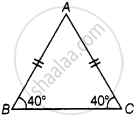
In ΔABC,
∠A + ∠B + ∠C = 180° ...[Angle sum property of a triangle]
⇒ ∠A + 40° + 40° = 180°
⇒ ∠A = 180° – 80°
⇒ ∠A = 100° ...[Obtuse angle]
Therefore, it is an obtuse-angled triangle. Since, it has one angle which is greater than 90°.
APPEARS IN
संबंधित प्रश्न
Find the perimeter of an equilateral triangle whose area is `16sqrt(3)"cm"`.
The area of an equilateral triangle is numerically equal to its perimeter. Find the length of its sides, correct two decimal places.
In a right-angled triangle PQR right-angled at Q, QR = x cm, PQ = (x + 7) cm and area = 30 cm2. Find the sides of the triangle.
In a right-angled triangle ABC, if ∠B = 90°, AB - BC = 2 cm; AC - BC = 4 and its perimeter is 24 cm, find the area of the triangle.
Find the area of an isosceles triangle whose perimeter is 50cm and the base is 24cm.
Find the area of an isosceles triangle whose perimeter is 72cm and the base is 20cm.
Each of the equal sides of an isosceles triangle is 4 cm greater than its height. If the base of the triangle is 24 cm; calculate the perimeter and the area of the triangle.
In an isosceles triangle, two angles are always ______.
In an isosceles triangle, angles opposite to equal sides are ______.
Two line segments are congruent, if they are of ______ lengths.
