Advertisements
Advertisements
प्रश्न
Each of the equal sides of an isosceles triangle is 4 cm greater than its height. If the base of the triangle is 24 cm; calculate the perimeter and the area of the triangle.
Advertisements
उत्तर
Each of equal sides of an isosceles triangle is 4 cm greater than its height.
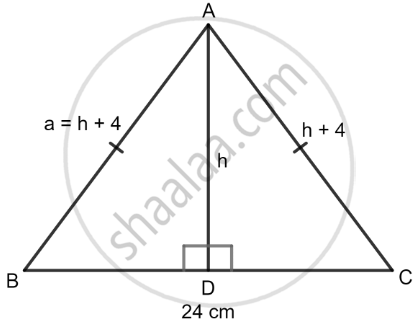
Let h be the height of the triangle.
Equal sides: AB = AC = h + 4
Base: BC = 24 cm
In ΔABD and ΔACD,
AD = AD ...[∵ Common Side]
∠ADB = ∠ADC ...[∵ Both are 90°]
AB = AC ...[∵ ΔABC is isosceles]
∴ ΔABD ≅ ΔACD ...[RHS axiom]
∴ BD = CD ...[C.P.C.T]
∴ BD = CD
= `"BC"/2`
= `24/2`
= 12 cm
By using the Pythagoras theorem in ΔABD,
BD2 + AD2 = AB2
⇒ 122 + h2 = (h + 4)2
⇒ 144 + h2 = h2 + 42 + 2 × h × 4
⇒ 144 + `\cancel("h"^2)` = `\cancel("h"^2)` + 16 + 8h
⇒ 144 – 16 = 8h
⇒ 128 = 8h
⇒ h = `128/8`
⇒ h = 16 cm
⇒ a = h + 4
= 16 + 4
= 20 cm
Perimeter of triangle = Sum of all sides
= AB + AC + BC
= (20 + 20 + 24) cm
= 64 cm
Area of triangle = `1/2` × base × height
= `1/2 xx 24 xx 16`
= 12 × 16
= 192 cm2
Hence, the perimeter is 64 cm and the area is 192 cm2.
