Advertisements
Advertisements
प्रश्न
If for ∆ABC and ∆DEF, the correspondence CAB `leftrightarrow` EDF gives a congruence, then which of the following is not true?
पर्याय
AC = DE
AB = EF
∠A = ∠D
∠C = ∠E
Advertisements
उत्तर
AB = EF
Explanation:
Given that ∆CAB ≅ ∆EDF
∴ AC = DE, AB = DF, BC = FE, ∠A = ∠D, ∠C = ∠E, ∠B = ∠F
APPEARS IN
संबंधित प्रश्न
I am a closed figure with each of my three angles is 60°. Who am I?
The given triangle is _________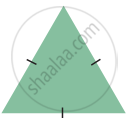
An equilateral triangle is
Measures of each of the angles of an equilateral triangle is ______.
If ∆PQR and ∆XYZ are congruent under the correspondence QPR `leftrightarrow` XYZ, then QR = ______.
If ∆PQR and ∆XYZ are congruent under the correspondence QPR `leftrightarrow` XYZ, then QP = ______.
If ∆PQR and ∆XYZ are congruent under the correspondence QPR `leftrightarrow` XYZ, then ∠Q = ______.
If ∆PQR and ∆XYZ are congruent under the correspondence QPR `leftrightarrow` XYZ, then RP = ______.
In an isosceles triangle, the two equal sides create:
Triangle ABC has sides AB = 7 cm, BC = 7 cm, and CA = 5 cm. This triangle is classified as:
