Advertisements
Advertisements
प्रश्न
If each edge of a cuboid of surface area S is doubled, then surface area of the new cuboid is
पर्याय
2 S
4 S
6 S
8 S
Advertisements
उत्तर
Let,
l →Length of the first cuboid
b → Breadth of the first cuboid
h → Height of the first cuboid
And,
L → Length of the new cuboid
B → Breadth of the new cuboid
H → Height of the new cuboid
We know that,
L = 2l
B = 2b
H=2h
Surface area of the first cuboid,
S = 2(lb + bh +hl )
Surface area of the new cuboid,
S' = 2 (LB + BH + HI .)
=2 [(2l)(2b)+(2b)(2h)+(2h)(2l)]
=2 ( 4lb + 4 bh +4hl)
=4[2(lb+bh+hl)]
= 4S
The surface area of the new cuboid is 4S.
APPEARS IN
संबंधित प्रश्न
A cubical box has each edge 10 cm and another cuboidal box is 12.5 cm long, 10 cm wide and 8 cm high.
(i) Which box has the greater lateral surface area and by how much?
(ii) Which box has the smaller total surface area and by how much?
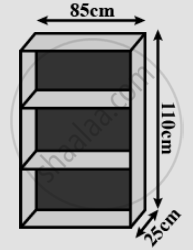
A wooden bookshelf has external dimensions as follows: Height = 110 cm, Depth = 25 cm, Breadth = 85 cm in following figure. The thickness of the plank is 5 cm everywhere. The external faces are to be polished and the inner faces are to be painted. If the rate of polishing is 20 paise per cm2 and the rate of painting is 10 paise per cm2. Find the total expenses required for polishing and painting the surface of the bookshelf.
A milk container is 8 cm long and 50 cm wide. What should be its height so that it can hold 4 litres of milk?
What will be the height of a cuboid of volume 168 m3, if the area of its base is 28 m2?
A tank is 8 m long, 6 m broad and 2 m high. How much water can it contain?
A closed iron tank 12 m long, 9 m wide and 4 m deep is to be made. Determine the cost of iron sheet used at the rate of Rs 5 per metre sheet, sheet being 2 m wide.
The length of a hall is 18 m and the width 12 m. The sum of the areas of the floor and the flat roof is equal to the sum of the areas of the four walls. Find the height of the wall.
The cost of constructing a wall 8 m long, 4 m high and 10 cm thick at the rate of Rs. 25 per m3 is
On a particular day, the rain fall recorded in a terrace 6 m long and 5 m broad is 15 cm. The quantity of water collected in the terrace is
Opposite faces of a cuboid are ______ in area.
