Advertisements
Advertisements
प्रश्न
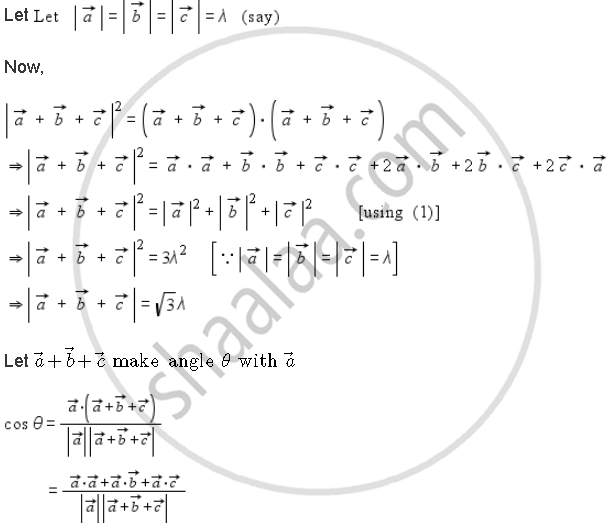
If `veca, vecb, vecc` are mutually perpendicular vectors of equal magnitudes, find the angle which `veca + vecb + vecc`make with `veca or vecb or vecc`
Advertisements
उत्तर


Thus, angle between `veca` and `veca+vecb+vecc` is `cos^(-1) (1/sqrt3)`
संबंधित प्रश्न
Find the magnitude of two vectors `veca and vecb`, having the same magnitude and such that the angle between them is 60° and their scalar product is `1/2`.
If `veca, vecb, vecc` are mutually perpendicular vectors of equal magnitudes, show that the vector `veca + vecb+ vecc` is equally inclined to `veca, vecb` and `vecc`.
Find the magnitude of the vector \[\vec{a} = 2 \hat{i} + 3 \hat{j} - 6 \hat{k} .\]
Find the unit vector in the direction of \[3 \hat{i} + 4 \hat{j} - 12 \hat{k} .\]
If the sum of two unit vectors is a unit vector prove that the magnitude of their difference is `sqrt(3)`.
Find a vector of magnitude of 5 units parallel to the resultant of the vectors \[\vec{a} = 2 \hat{i} + 3 \hat{j} - \hat{k} \text{ and } \vec{b} = \hat{i} - 2 \hat{j} +\widehat{k} .\]
A vector \[\vec{r}\] is inclined at equal angles to the three axes. If the magnitude of \[\vec{r}\] is \[2\sqrt{3}\], find \[\vec{r}\].
Write a vector of magnitude 12 units which makes 45° angle with X-axis, 60° angle with Y-axis and an obtuse angle with Z-axis.
Write the length (magnitude) of a vector whose projections on the coordinate axes are 12, 3 and 4 units.
Find a vector in the direction of \[\overrightarrow{a} = 2 \hat{i} - \hat{j} + 2 \hat{k} ,\] which has magnitude of 6 units.
Write two different vectors having same magnitude.
Find a vector in the direction of vector \[2 \hat{i} - 3 \hat{j} + 6 \hat{k}\] which has magnitude 21 units.
If in a ∆ABC, A = (0, 0), B = (3, 3 \[\sqrt{3}\]), C = (−3\[\sqrt{3}\], 3), then the vector of magnitude 2 \[\sqrt{2}\] units directed along AO, where O is the circumcentre of ∆ABC is
A vector `vec"r"` is inclined at equal angles to the three axes. If the magnitude of `vec"r"` is `2sqrt(3)` units, find `vec"r"`.
Prove that in any triangle ABC, cos A = `("b"^2 + "c"^2 - "a"^2)/(2"bc")`, where a, b, c are the magnitudes of the sides opposite to the vertices A, B, C, respectively.
The vector in the direction of the vector `hat"i" - 2hat"j" + 2hat"k"` that has magnitude 9 is ______.
Let `vecalpha = hati + 2hatj - hatk, vecbeta = 2hati - hatj + 3hatk, vecγ = 2hati + hatj + 6hatk`. If `vecalpha` and `vecbeta` are both perpendicular to a vector `vecδ` and `vecδ. vecγ` = 10, then the magnitude of `vecδ` is
The area under a velocity-time curve represents the change in ______?
Which of the following statements is false about forces/ couple?
In a triangle ABC three forces of magnitudes `3vec(AB), 2vec(AC)` and `6vec(CB)` are acting along the sides AB, AC and CB respectively. If the resultant meets AC at D, then the ratio DC : AD will be equal to :
The magnitude of the vector `6hati - 2hatj + 3hatk` is ______.
Find a vector of magnitude 9 units and perpendicular to the vectors.
`veca = 4hati - hatj + hatk` and `vecb = -2hati + hatj - 2hatk`