Advertisements
Advertisements
प्रश्न
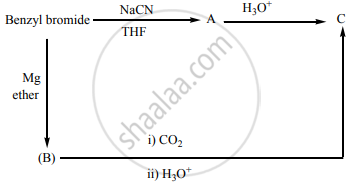
Identify A, B and C.
Advertisements
उत्तर
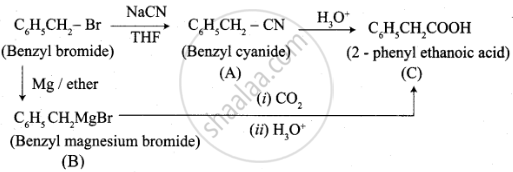
| A | C6H5CH2CN | Benzyl cyanide |
| B | C6H5CH2MgBr | Benzyl magnesium bromide |
| C | C6H5CH2COOH | 2-Phenyl ethanoic acid |
APPEARS IN
संबंधित प्रश्न
Write reaction showing aldol condensation of cyclohexanone.
Answer in brief.
Write reaction showing conversion of Acetaldehyde into acetaldehyde dimethyl acetal.
Addition of sodium bisulphite to ethanol is ____________ type of reaction.
Explain haloform reaction with suitable example.
\[\begin{array}{cc} \phantom{...}\ce{R}\phantom{.................}\ce{R}\phantom{..}\ce{H}\phantom{................}\\ \phantom{...}\backslash\phantom{..................}\backslash/\phantom{..........}\phantom{.......}\\ \ce{C = O ->[H2NNH2][KOH/glycol] C + N2 + H2O}\\ \phantom{}/\phantom{............}\phantom{.......}/\phantom{}\backslash\phantom{...............}\\ \phantom{}\ce{R}\phantom{..................}\ce{R}\phantom{..}\ce{H}\phantom{...............} \end{array}\]
Reaction is called ____________.
Assertion: 2, 2-dimethyl propanoic acid does not give HVZ reaction.
Reason: 2-2, dimethyl propanoic acid does not have α-hydrogen atom.
Give two examples which undergo Wolf-Kishner reduction.
Write the structure of the major product of the aldol condensation of benzaldehyde with acetone.
Write the structure of the major product of the aldol condensation of benzaldehyde with acetone.
The products formed in the following reaction, A and B are: