Advertisements
Advertisements
प्रश्न
How will you explain the statement 'we cannot see the objects in a dark room'?
Advertisements
उत्तर
Light enables us to see objects around us. We see an object when light falls on it and gets reflected from its surface and enters our eyes. In a dark room, there is no source of light. Thus, no light falls on the surface of objects, and hence we do not see them. This is why we cannot see the objects in a dark room.
संबंधित प्रश्न
The reflection of light from a wooden surface is _________ reflection.
A light ray is incident normally on a plane mirror. (a) What is its angle of incidence?
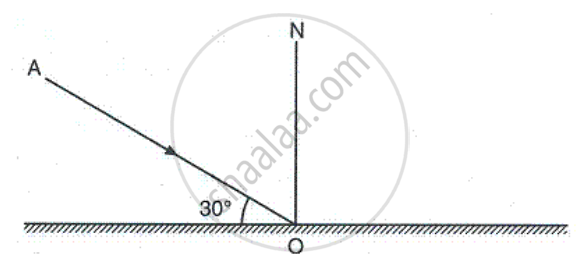
Figure shows an incident ray AO and the normal ON on a plane mirror. The angle which the incident ray AO makes with mirror is 30°. (a) Find the angle of incidence. (b) Draw the reflected ray and then find the angle between the incident and reflected rays.
You are provided a convex mirror, a concave mirror and a plane mirror. How will you distinguish between them, without touching or using any other apparatus?
State whether the following statement is true or false. If false, correct it.
If the incident ray makes an angle of Xo with the normal, then the reflected ray is 2Xo.
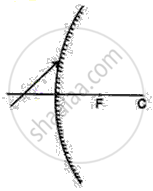
Complete the path of incident ray in the following case.
Dull materials reflect light.
Which position of the object will produce a magnified virtual image, if a concave mirror of focal length 15 cm is being used?
