Advertisements
Advertisements
प्रश्न
The diagram in Figure shows a point object P in front of a plane mirror MM1.
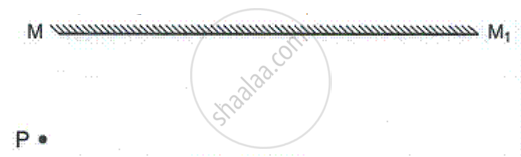
(a) Complete the diagram by taking two rays from the point P to show the formation of its image.
(b) In the diagram, mark the position of eye to see the image.
(c) Is the image formed real or virtual? Explain why?
Advertisements
उत्तर
(a) and (b)

(c) The image formed is virtual because the reflected rays meet when produced backwards.
APPEARS IN
संबंधित प्रश्न
What do you mean by the term reflection of light ?
Wirte down the letter C and I as seen in a plane mirror.
Explain the differences between regular and irregular reflection light.
An object is placed 2 cm from a plane mirror. If the object is moved by 1 cm towards the mirror, what will be the distance between the object and its new image?
You are provided a convex mirror, a concave mirror and a plane mirror. How will you distinguish between them, without touching or using any other apparatus?
What is a real image?
State whether the following statement is true or false. If false, correct it.
The image in a plane mirror is situated in the mirror.
What happens when light hits a transparent object?
