Advertisements
Advertisements
प्रश्न
How will you differentiate between a convex and a concave lens by looking at a distant object.
Advertisements
उत्तर
On seeing a distant object through the lens, if its inverted image is seen, then the lens is convex, and if the upright image is seen, then the lens is concave.
संबंधित प्रश्न
What is a lens?
Explain optical centre of a lens with the help of proper diagram(s).
In figure, (a) and (b), F1 and F2 are the two foci of thin lenses and AB is the incident ray. Complete the diagram to show the path of the ray AB after refraction through each lens.
 |
| (a) |
 |
| (b) |
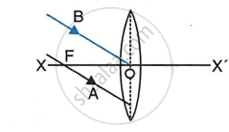
In the diagram below, XX’ represents the principal axis, O the optical centre and F the focus of the lens. Complete the path of rays A and B as they emerge out of the lens.
 |
 |
| (a) | (b) |
The diagram given below shows the position of an object OA in relation to a converging lens whose foci are at F1 and F2.
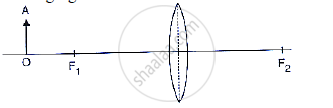
Describe three characteristic of the image.
(a) Draw a sketch to show how a lens is able to produce an image of the sun on a paper screen.
(b)(i) Would you regard the rays from the sun as being divergent, parallel or convergent?
(ii) What is the name given to the point where such rays meet after they have passed through the lens?
(iii) How does the image of the sun sometimes burn a paper screen?
How will you differentiate between a convex and a concave lens by looking at a printed page?
Mixture of red + blue + green is passed through a convex lens as shown in the diagram below. State whether the ray passes through a single point or through different points on the principal axis after refraction.

