Advertisements
Advertisements
प्रश्न
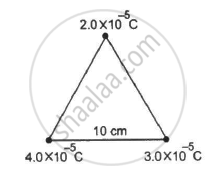
How much work has to be done in assembling three charged particles at the vertices of an equilateral triangle, as shown in the figure?
Advertisements
उत्तर
Let
Side of the equilateral triangle = l
As
Work done in assembling the charges = Net potential energy of the system
\[\Rightarrow W = U_{12} + U_{13} + U_{23} \]
\[ \Rightarrow W = \frac{1}{4\pi \epsilon_0}\left( \frac{q_1 q_2}{l} + \frac{q_1 q_3}{l} + \frac{q_2 q_3}{l} \right)\]
\[ = \frac{9 \times {10}^3}{{10}^{- 1}} \times {10}^{- 10} [4 \times 2 + 4 \times 3 + 3 \times 2]\]
\[ = 9 \times (8 + 12 + 6)\]
\[ = 9 \times 26 = 234 \] J
APPEARS IN
संबंधित प्रश्न
- Two insulated charged copper spheres A and B have their centers separated by a distance of 50 cm. What is the mutual force of electrostatic repulsion if the charge on each is 6.5 × 10⁻⁷ C? The radii of A and B are negligible compared to the distance of separation.
- What is the force of repulsion if each sphere is charged double the above amount, and the distance between them is halved?
Write any two important points of similarities and differences each between Coulomb's law for the electrostatic field and Biot-Savart's law of the magnetic field ?
One end of a 10 cm long silk thread is fixed to a large vertical surface of a charged non-conducting plate and the other end is fastened to a small ball of mass 10 g and a charge of 4.0× 10⁻⁶ C. In equilibrium, the thread makes an angle of 60° with the vertical. Find the surface charge density on the plate.
Two insulating small spheres are rubbed against each other and placed 1 cm apart. If they attract each other with a force of 0.1 N, how many electrons were transferred from one sphere to the other during rubbing?
Three equal charges, 2.0 × 10⁻⁶ C each, are held at the three corners of an equilateral triangle of side 5 cm. Find the Coulomb force experienced by one of the charges due to the other two.
A particle A with a charge of 2.0 × 10⁻⁶ C and a mass of 100 g is placed at the bottom of a smooth inclined plane of inclination 30°. Where should another particle B, with the same charge and mass, be placed on the incline so that it may remain in equilibrium?
Two particles A and B, each carrying a charge Q, are held fixed with a separation dbetween them. A particle C of mass m and charge q is kept at the middle point of the line AB. Under what conditions will the particle C execute simple harmonic motion if it is released after such a small displacement? Find the time period of the oscillations if these conditions are satisfied.
Two particles A and B possessing charges of +2.00 × 10⁻⁶ C and of −4.00 × 10⁻⁶ C, respectively, are held fixed at a separation of 20.0 cm. Locate the points (s) on the line AB, where (a) the electric field is zero (b) the electric potential is zero.
What is relative permittivity?
Three charges +Q, q, +Q are placed respectively, at distance, 0, d/2 and d from the origin, on the X-axis. If the net force experienced by +Q, placed at x = 0, is zero then value of q is ____________.
The force between two charges 0.06 m apart is 5 N. If each charge is moved towards the other by 0.01 m, then the force between them will become ______.
For charges q1 and q2 separated by a distance R the magnitude of the electrostatic force is given by ______.
Two identical thin rings, each of radius a meter, are coaxially placed at a distance R meter apart. If Q1 coulomb and Q2 coulomb are respectively the charges uniformly spread on the two rings, the work done in moving a charge q coulomb from the centre of one ring to that of the other is ______.
Four equal charges q are placed at the four comers A, B, C, D of a square of length a. The magnitude of the force on the charge at B will be ______.

A spring of spring constant 5 × 10³ N/m is stretched initially by 5 cm from the unstretched position. Then the work required to stretch it further by another 5 cm is:
Coulomb's law is given by F = k q1q2 rn where n is
According to Coulomb's law, which is the correct relation for the following figure?

The ratio of the forces between two charges placed at a certain distance apart in the air and by the same distance apart in a medium of dielectric constant K is ______.
