Advertisements
Advertisements
प्रश्न
How are various elements of the hydrological cycle interrelated?
Advertisements
उत्तर
Water is a cyclic resource. It can be used and re-used. Water also undergoes a cycle from the atmosphere, land surface and subsurface, and the organisms. About 71 percent of the planetary water is found in the oceans. The remaining is held as freshwater in glaciers and ice caps, groundwater sources, lakes, soil moisture, atmosphere, streams, and within life. Nearly 59 percent of the water that falls on land returns to the atmosphere through evaporation from over the oceans as well as from other places. The remainder runs off on the surface infiltrates into the ground or a part of it becomes a glacier. The renewable water on the earth is constant while the demand is increasing tremendously. This leads to the water crisis in different parts of the world - spatially and temporally. The pollution of river waters has further aggravated the crisis.
APPEARS IN
संबंधित प्रश्न
The process of changing of water from gaseous to liquid form is known as ______.
The evaporation of water from the leaves of plants is called.
The degree of water vapour present in the atmosphere is known as__________.
Evaporation refers to
- The process in which the gaseous form of water changes into liquid form
- It refers to the process in which the liquid form of water changes into a gaseous form.
- Water boils at 100o C temperature but, it actually begins to evaporate at 0o C.
- It is responsible for the formation of clouds.
Water boils at 212° F temperature but, it begins to evaporate at 32° F.
Mist is not the tiny droplets of water hanging in the air.
How is the dew formation takes place?
Find out the missing components of hydrologic cycle in the given diagram and fill it up appropriately.
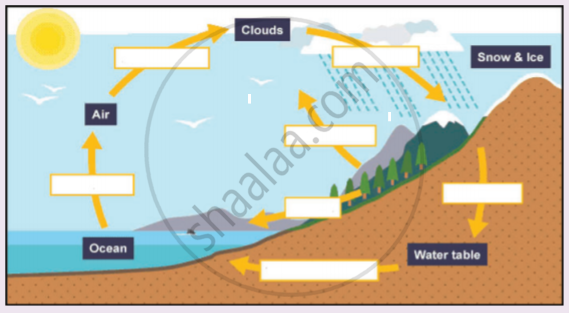
Identify the element which is not a part of the hydrological cycle.
The evaporation is more than precipitation in the ______.
The three important phases of the hydrologic cycle are ______, ______, and ______.
There is a ______ relationship between temperature and evaporation.
Saturation occurs when the temperature increases.
Evaporation is the process in which the liquid form of water changes into a gaseous form.
What are the factors that increase the rate of evaporation?
Explain the forms of condensation.
______ takes place from the surface water.
Over the oceans, ______ is more prevalent than precipitation.
The rate of evaporation is ______ during the periods of calm winds.
______ is formed by microscopic drops of water or by small ice crystals.
______ is the tiny droplets of water hanging in the air.
When does the rate of evaporation increase?
Write three factors that affect transpiration.
Where do condensation and saturation occur?
