Advertisements
Advertisements
प्रश्न
Identify the element which is not a part of the hydrological cycle.
पर्याय
Evaporation
Hydration
Precipitation
Condensation
Advertisements
उत्तर
Hydration
APPEARS IN
संबंधित प्रश्न
The process of changing of water from gaseous to liquid form is known as ______.
The evaporation of water from the leaves of plants is called.
The degree of water vapour present in the atmosphere is known as__________.
Match the following
| 1. | Vegetation | Clouds |
| 2. | Condensation | Sleet |
| 3. | Snow and raindrops | At the surface |
| 4. | Infiltration | Transpiration |
Water boils at 212° F temperature but, it begins to evaporate at 32° F.
Mist is not the tiny droplets of water hanging in the air.
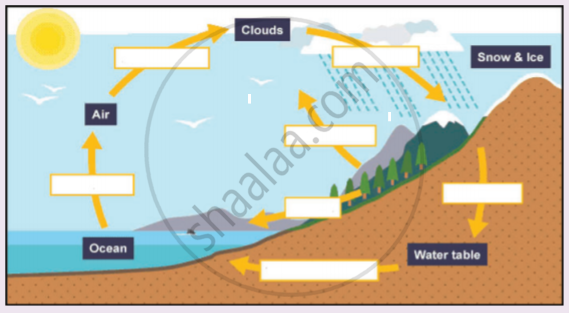
Find out the missing components of hydrologic cycle in the given diagram and fill it up appropriately.
The process of change of water into gaseous form is called ______.
______ is the prime element which affects the rate of evaporation.
The evaporation is more than precipitation in the ______.
The process of change of gaseous form of water into liquid form is called as ______.
Rain is the tiny droplets of water hanging in the air.
Evaporation is the process in which the liquid form of water changes into a gaseous form.
Over the oceans, ______ is more prevalent than precipitation.
The rate of evaporation is ______ during the periods of calm winds.
For aviation purpose, the criterion for fog is ______ or less.
Transpiration takes place from ______.
______ is the tiny droplets of water hanging in the air.
When does the rate of evaporation increase?
Write three factors that affect transpiration.
Where do condensation and saturation occur?
Explain the three major forms of condensation.
