Advertisements
Advertisements
प्रश्न
Given below is the diagram of human ovum surrounded by a few sperms. Observe the diagram and answer the questions that follows:
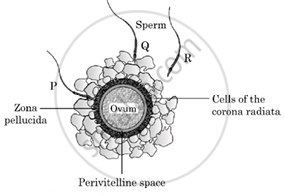
- Compare the fate of sperms ‘P’, ‘Q’ and ‘R’ shown in the diagram.
- Write the role of Zona pellucida in this process.
- Analyse the changes occurring in the ovum after the entry of sperm.
- How acrosome and middle piece of a human sperm are able to play an important role in human fertilization?
सविस्तर उत्तर
Advertisements
उत्तर
- Sperm P: This sperm seems to be breaking through the ovum's (egg) outer covering, the zona pellucida. Sperm P is probably going to fertilize the ovum.
Sperm Q: The corona radiata cells that surround the zona pellucida contain this sperm. Sperm Q will probably finally make it to the zona pellucida and try to fertilise it.
Sperm R: The corona radiata does not include this sperm. Sperm R might make it to the ovum, but it might not be able to enter and fertilize the egg. - Role of Zona Pellucida in Fertilisation: By blocking the admission of additional sperm once one sperm has entered, the zona pellucida promotes species-specific sperm binding and avoids polyspermy.
- Changes in the ovum after sperm entry: To stop multiple sperm entrance, the zona pellucida hardens.
Completion of meiosis II: After completing meiosis, the secondary oocyte forms the second polar body and the ovum.
Formation of male and female pronuclei: The female nucleus merges with the decondensed sperm nucleus. - Role of acrosome and middle piece in fertilisation:
Acrosome: It includes the enzymes acrosin and hyaluronidase, which break down the zona pellucida to allow sperm access.
Middle piece: It has mitochondria, which give sperm the ATP they need to move and reach the ovum.
shaalaa.com
या प्रश्नात किंवा उत्तरात काही त्रुटी आहे का?
2024-2025 (March) Delhi Set 1
