Advertisements
Advertisements
प्रश्न
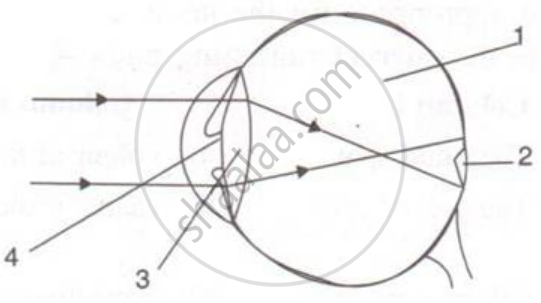
Given below is a diagram depicting a defect of the human eye? Study the same and answer the question that follow:

Name the parts labeled 1 to 4.
Advertisements
उत्तर
1 - vitreous humour,
2 - Fovea centralis (yellow spot),
3-lens,
4-pupil
संबंधित प्रश्न
the biological/technical terms for the lens of eye losing flexibility resulting in a kind of long-sightedness in middle aged people.
What is the scientific name of
short-sightedness
What is the scientific name of
long-sightedness?
Explain with the help of labelled ray diagram, the defect of vision called myopia and how it is corrected by a lens.
A person suffering from the eye-defect myopia (short-sightedness) can see clearly only up to a distance of 2 metres. What is the nature and power of lens required to rectify this defect?
What is meant by optical illusion? Give one example.
Given below is a diagram depicting a defect of the human eye? Study the same and answer the question that follow:
Give two possible reasons for this defect of the eye in human beings.
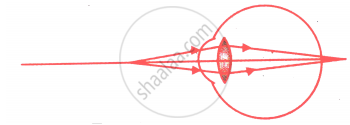
Given below is a diagram showing a defect of vision. Name the defect of vision and draw an accurately labelled diagram to correct this defect.
Myopia and hypermetropia can be corrected by:
