Advertisements
Advertisements
प्रश्न
Give scientific reasons:
On complete hydrolysis DNA gives equimolar quantities of adenine and thymine.
Why on complete hydrolysis DNA gives equimolar quantities of adenine and thymine?
Advertisements
उत्तर
- Both the strands of DNA double helix are complementary to each other.
- That is a number of bases on each strand are equal and complementary to each other.
- As adenine pairs with thymine; the number of adenine bases on one strand and thymine on another are equal in number.
Thus, on complete hydrolysis DNA gives equimolar quantities of adenine and thymine.
संबंधित प्रश्न
In which of the following structure of DNA carries genetic information of the organism?
Write the name of the base present in DNA but not found in RNA.
Draw structure of following.
2-Deoxy-D-ribose
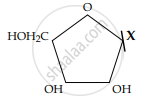
Given below is the diagrammatic representation of one of the categories of small molecular weight organic compounds in the living tissues. Identify the category shown & one blank component “ X” in it.
Distinguish between Nitrogen base and a base found in inorganic chemistry.
Write the characteristic feature of DNA.
Explain the structure and function of different types of RNA.
Pentose sugar present in RNA is ______
In 1924, Feulgen showed that ______ contain DNA.
Watson and Crick are known for their discovery of ______.
In which of the following RNA is genetic material?
DNA consists of two complementary nucleotide chains. If the sequence of nucleotide in one of the chains is 5' AGCTTCGA3', then the nucleotide sequence in the other chain shall be ______.
DNA differs from RNA in ______.
Purine derivative among the following bases is ____________.
Nucleotides are linked together through ____________.
Give any three differences between DNA and RNA.
Complete the flow chart on central dogma.

If Adenine makes 30% of the DNA molecule, what will be the percentage of Thymine, Guanine, and Cytosine in it?
Building block of nucleic acid is ______.
Give names of the purines.
Watson and Crick (1953) proposed DNA double helix model and won the Nobel Prize; their model of DNA was based on:
- X-ray diffraction studies of DNA were done by Wilkins and Franklin.
- Chargaff’s base equivalence rule
- Griffith's transformation experiment
- Meselson and Stahl's experiment
Which of the following are correct combination of purine bases?
Match List - I with List - II.
| List - I | List - II |
| A. Adenosine | I. Nitrogen base |
| B. Adenylic acid | II. Nucleotide |
| C. Adenine | III. Nucleoside |
| D. Alanine | IV. Amino acid |
Choose the option with all correct matches.
Which scientist discovered and isolated nucleic acids from pus cells in 1869?
Which pentose sugar is found specifically in DNA?
According to Chargaff's Rule, what is the relationship between purines and pyrimidines in DNA?
