Advertisements
Advertisements
प्रश्न
Give reasons.
There is mixed economy in Brazil and India.
Give geographical reasons:
There is mixed economy in Brazil and India.
Advertisements
उत्तर १
- A mixed economy includes both the commercial and public sectors.
- In mixed economies, both the public and private sectors own diverse sectors such as banking, railways, airways, power production, the iron and steel industry, health, education, and telecommunications.
- Its main goal is to strike a balance between profit and social welfare.
- The public sector focuses on providing essential services and infrastructure to support society’s welfare.
- A mixed economy helps in reducing economic inequalities by supporting the weaker sections of society.
- It ensures economic stability by combining government planning with market forces.
All these characteristics of a mixed economy are present in Brazil and India. Therefore, there is a mixed economy in both countries.
उत्तर २
- In a mixed economy, the private sector and public (government) sector coexist.
- In Brazil as well as in India, the sectors like railway, electricity production, iron and steel industry, etc are owned and managed by public (government) sector.
- In Brazil as well as in India, the sectors like banking, airways, health, education, telecommunication, etc., are owned and managed by private as well as public (government) sectors. In this way, there is a mixed economy in Brazil and India.
Notes
Students should refer to the answer according to their preferred marks.
APPEARS IN
संबंधित प्रश्न
Brazil’s economy is also of ---------------- type like that of India.
Between India and Brazil, whose per capita income is less?
Mark the following in the outline map of Brazil supplied to you, write the names and give index

- Marajó Island
- Pico-De-Neblina
- Pantanal Wetland
- Drought Quadrilateral
- Caatinga
- Golden Lion-Tamarin
India’s per capita income is less than Brazil due to ______.
Classify the following activities in by ticking (✓) in the respective column.
| Activities | Primary | Secondary | Tertiary |
| Television Broadcasting | |||
| Bee-keeping | |||
| Coir and Rope making | |||
| Jaggery-making | |||
| Producing blades of the plough. |
|||
| Construction | |||
| Extracting Iron Ore | |||
| Automobile Production | |||
| Rice Production | |||
| Teaching | |||
| Driving buses | |||
| Providing lodging and boarding facilities |
Which type of occupations gives a boost to the development of a country’s economy?
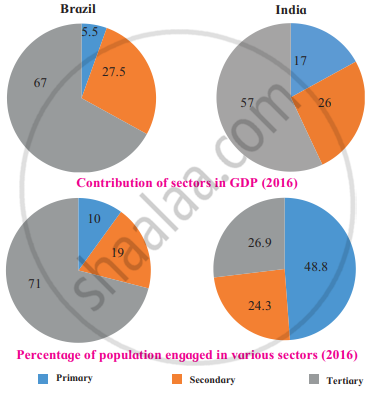
With the help of the pie chart given in the fig., tell what the contribution of secondary activities is to Brazil’s GDP?
Distinguish Between:
Occupations in India and Brazil.
India and Brazil are progressing in the fields of ______ education and industry.
Read the following graph and answer the questions:
India and Brazil
Contribution of sectors in national income and percentage of population engaged in the sector.

Questions:
- Name the sectors mentioned in the graph.
- Which sector contributes the highest in National income in India?
- How much percent of population is engaged in primary sector in Brazil?
- Out of given two countries, the share of primary sector to the national income is less.
- Which country's contribution of tertiary sector to the national income is less?
- In which sector 19% population of Brazil is engaged?
