Advertisements
Advertisements
प्रश्न
Give Reasons
The full-grown human embryo respires but does not breathe.
Advertisements
उत्तर
The full-grown human embryo respires because the dissolved oxygen in the mother’s blood diffuses into the embryo and is used in the oxidation of glucose in the cells with the liberation of energy. However there are no breathing movements as the lungs lie collapsed in the embryo and the only function after the fetus is expelled from the mother’s body. Therefore no breathing movements in the embryo as it receives oxygen by diffusion of gases.
संबंधित प्रश्न
Name the following:
The fluid surrounding the developing embryo
Name the following:
The body part in which the embryo develops.
Given below is the name of certain stage/substance related to reproduction and found in human body. Answer the questions related to it.
Placenta
- What are the two sources that form placenta?
- Name any two main substances which pass from foetus to mother through placenta.
- Name any two hormones it produces.
How is Placenta formed? What are its functions?
Mention three functions of the placenta.
Differentiate
Amnion and Chorion.
Study the diagram given below and then answer the questions that follow:
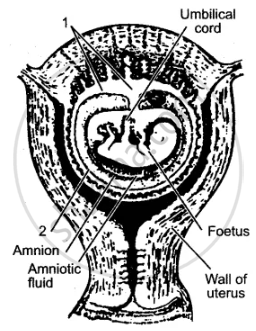
(i) Name the parts labeled 1 and 2. State the function of each part.
(ii) State any one function of the amniotic fluid.
(iii) What is the role of the umbilical cord in the development of the fetus?
(iv) Name the part in the diagram which is endocrine in nature.
Name the Following
How the embryo inside the uterus is protected from jerks or mechanical shocks.
Match the respiratory surfaces to the organisms in which they are found.
| Organ/ cells | Hormones | ||
| (i) | Corpus luteum | (a) | HCG |
| (ii) | Leydig's cells | (b) | Estrogen |
| (iii) | Placenta | (c) | Progesterone |
| (iv) | Graafian follicle | (d) | Testosterone |
Which nitrogenous waste product is removed from the foetus by the placenta through diffusion into maternal bloodstream?
