From a cubical piece of wood of side 21 cm, a hemisphere is carved out in such a way that the diameter of the hemisphere is equal to the side of the cubical piece.
Advertisements
प्रश्न
From a cubical piece of wood of side 21 cm, a hemisphere is carved out in such a way that the diameter of the hemisphere is equal to the side of the cubical piece. Find the surface area and volume of the remaining piece.
Advertisements
उत्तर

We have,
The edge of the cubical piece, a = 21 cm and
The radius of the hemisphere, `r = a/2 = 21/2` cm
The surface area of the remaining piece = TSA of cube + CSA of hemisphere – Area of circle
= 6a2 + 2πr2 – πr2
= 6a2 + πr2
`= 6 xx 21xx21xx22/7xx21/2xx21/2`
`= 21xx21(6 + 22/(7+4))`
`= 21xx21(6+11/14)`
`=21xx21((84+11)/14)`
`= 21xx3(95/2)`
= 2992.5 cm2
Also,
Volume of the remaining piece = Volume of the cube – Volume of the hemisphere
`= a^3 - 2/3pir^3`
`= 21xx21xx21 - 2/3xx22/7xx(21/2)xx(21/2)xx(21/2)`
`= 21xx21xx21xx(1-2/3xx22/7xx1/2xx1/2xx1/2)`
`= 21xx21xx21(1/1 - 11/42)`
`=21xx21xx21xx((42-11)/42)`
`= 21xx21xx(31/2)`
= 6835.5 cm3
APPEARS IN
संबंधित प्रश्न
504 cones, each of diameter 3.5 cm and height 3 cm, are melted and recast into a metallic sphere. Find the diameter of the sphere and hence find its surface area.
[Use π=22/7]
If the total surface area of a solid hemisphere is 462 cm2 , find its volume.[Take π=22/7]
A right circular cone of radius 3 cm, has a curved surface area of 47.1 cm2. Find the volume of the cone. (use π 3.14).
A cubical block of side 7 cm is surmounted by a hemisphere. What is the greatest diameter the hemisphere can have? Find the surface area of the solid. [Use `pi = 22/7`]
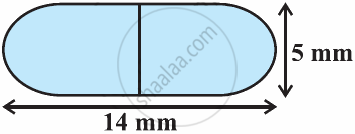
A medicine capsule is in the shape of cylinder with two hemispheres stuck to each of its ends (see the given figure). The length of the entire capsule is 14 mm and the diameter of the capsule is 5 mm. Find its surface area. [Use π = `22/7`]
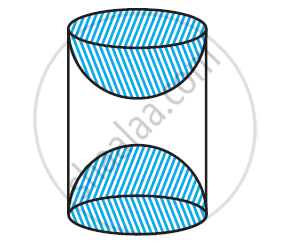
A wooden article was made by scooping out a hemisphere from each end of a solid cylinder, as shown in given figure. If the height of the cylinder is 10 cm, and its base is of radius 3.5 cm, find the total surface area of the article.
[Use `pi = 22/7`]
A milk container is made of metal sheet in the shape of frustum of a cone whose volume is 10459 `3/7` cm3. The radii of its lower and upper circular ends are 8cm and 20cm. find the cost of metal sheet used in making container at rate of Rs 1.4 per cm2?
From a solid cylinder of height 7 cm and base diameter 12 cm, a conical cavity of same height and same base diameter is hollowed out. Find the total surface area of the remaining solid. [User `pi22/7`]
A solid metal sphere of 6 cm diameter is melted and a circular sheet of thickness 1 cm is prepared. Determine the diameter of the sheet.
A solid is in the form of a cylinder with hemispherical ends. Total height of the solid is 19 cm and the diameter of the cylinder is 7 cm. Find the volume and total surface area of the solid.
From a solid cylinder of height 2.8 cm and diameter 4.2 cm, a conical cavity of the same height and same diameter is hollowed out. Find the total surface area of the remaining solid.
A hemispherical bowl of internal diameter 30 cm contains some liquid. This liquid is to be poured into cylindrical bottles of diameter 5 cm and height 6 cm each. Find the number of bottles required.
How many lead shots each 3 mm in diameter can be made from a cuboid of dimensions 9 cm × 11 cm × 12 cm?
If the surface areas of two spheres are in ratio 16 : 9, then their volumes will be in the ratio ______.
The radius of spherical balloon increases from 8 cm to 12 cm. The ratio of the surface areas of balloon in two cases is ______.
If two solid hemispheres of same base radius r are joined together along their bases, then curved surface area of this new solid is ______.
There are two identical solid cubical boxes of side 7 cm. From the top face of the first cube a hemisphere of diameter equal to the side of the cube is scooped out. This hemisphere is inverted and placed on the top of the second cube’s surface to form a dome. Find
- the ratio of the total surface area of the two new solids formed
- volume of each new solid formed.
