मराठी

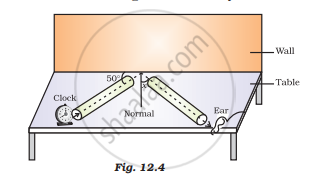
For hearing the loudest ticking sound heard by the ear, find the angle x in Fig.12.4. - Science

Advertisements
Advertisements

प्रश्न

For hearing the loudest ticking sound heard by the ear, find the angle x in Fig.12.4.
थोडक्यात उत्तर
Advertisements

उत्तर

For hearing the loudest ticking sound, the angle made by incident sound with normal = angle made by reflected sound wave with normal = x

Now, the angle made by incident sound with normal

= 90° – 50°

= 40°

∴ x = 40°

shaalaa.com
  या प्रश्नात किंवा उत्तरात काही त्रुटी आहे का?
पाठ 12: Sound - Short Answer Question [पृष्ठ ७३]

APPEARS IN

एनसीईआरटी एक्झांप्लर Science [English] Class 9
पाठ 12 Sound
Short Answer Question | Q 16. | पृष्ठ ७३

व्हिडिओ ट्यूटोरियलVIEW ALL [1]

संबंधित प्रश्‍न

What is the range of frequencies associated with infrasound?


Name the organs of hearing in our body.


Can we hear (a) infrasonic waves (b) ultrasonic waves ?


What name is given to the sound waves of frequency too low for humans to hear ?


Choose the infrasonic waves and ultrasonic waves from the following frequencies : 
(i) 10,000 Hz
(ii) 30,000 Hz
(iii) 18 Hz
(iv) 50,000 Hz
(v) 10 Hz 


Which of the following sound frequencies cannot be heard by a human ear ?

(i) 10 Hz
(ii) 100 Hz
(iii) 10,000 Hz
(iv) 15 Hz
(v) 40,000 Hz 


Three different vibrating objects produce three-types of sounds X, Y and Z. Sounds X and Y cannot be heard by a man having normal range of hearing but sound Z can be heard easily. The sound X is used in hospitals to break kidney stones of a patient into fine grains which then get flushed out with urine. The sound Y is similar to that which is produced during an earthquake before the main shock wave is generated.

(a) What type of sounds are (i) X (ii) Y, and (iii) Z ?
(b) Name one device which can produce sound like X.
(c) Name one device in a science laboratory which can produce sound like Y.
(d) Name one device in our homes which can produce sound like Z.
(e) What is the frequency range of sounds like Z ?


One of the following can hear infrasound. This one is :


Which of the above two graphs (a) and (b) (Fig.12.3) representing the human voice is likely to be the male voice? Give a reason for your answer.


A girl is sitting in the middle of a park of dimension 12 m × 12 m. On the left side of it, there is a building adjoining the park and on the right side of the park, there is a road adjoining the park. A sound is produced on the road by a cracker. Is it possible for the girl to hear the echo of this sound? Explain your answer.


Share
Notifications

Englishहिंदीमराठी


      Forgot password?
Use app×