Advertisements
Advertisements
प्रश्न
Find the vector equation of the plane passing through the intersection of the planes `vecr.(2hati + 2hatj - 3hatk) = 7, vecr.(2hati + 5hatj + 3hatk) = 9` and through the point (2, 1, 3)
Advertisements
उत्तर
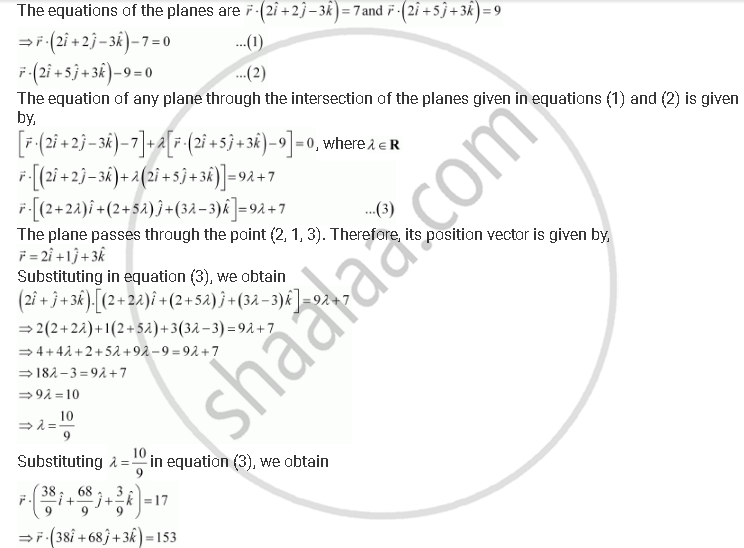
This is the vector equation of the required plane.
APPEARS IN
संबंधित प्रश्न
Find the equation of the plane through the intersection of the planes 3x – y + 2z – 4 = 0 and x + y + z – 2 = 0 and the point (2, 2, 1).
Find the equation of the plane passing through the line of intersection of the planes `vecr.(hati + hatj + hatk) = 1` and `vecr.(2hati + 3hatj -hatk) + 4 = 0` and parallel to x-axis.
Find the equation of the plane which contains the line of intersection of the planes `vecrr.(hati + 2hatj + 3hatk) - 4 = 0, vecr.(2hati + htj - hatk) + 5 = 0`, and which is perpendicular to the plane `vecr.(5hati + 3hatj - 6hatk) + 8 = 0`.
Find the coordinates of the point where the line \[\frac{x - 2}{3} = \frac{y + 1}{4} = \frac{z - 2}{2}\] intersects the plane x − y + z − 5 = 0. Also, find the angle between the line and the plane.
Find the distance of the point (−1, −5, −10) from the point of intersection of the line \[\vec{r} = \left( 2 \hat{i} - \hat{j} + 2 \hat{k} \right) + \lambda\left( 3 \hat{i}+ 4 \hat{j} + 2 \hat{k} \right)\] and the plane \[\vec{r} . \left( \hat{i} - \hat{j} + \hat{k} \right) = 5 .\]
Find the distance of the point (2, 12, 5) from the point of intersection of the line \[\vec{r} = 2 \hat{i} - 4 \hat{j}+ 2 \hat{k} + \lambda\left( 3 \hat{i} + 4 \hat{j} + 2 \hat{k} \right)\] and \[\vec{r} . \left( \hat{i} - 2 \hat{j} + \hat{k} \right) = 0\]
Find the distance of the point P(−1, −5, −10) from the point of intersection of the line joining the points A(2, −1, 2) and B(5, 3, 4) with the plane \[x - y + z = 5\] .
Find the distance of the point (1, -5, 9) from the plane
Find the equation of the plane which contains two parallel lines\[\frac{x - 4}{1} = \frac{y - 3}{- 4} = \frac{z - 2}{5}\text{ and }\frac{x - 3}{1} = \frac{y + 2}{- 4} = \frac{z}{5} .\]
Show that the lines \[\frac{x + 4}{3} = \frac{y + 6}{5} = \frac{z - 1}{- 2}\] and 3x − 2y + z + 5 = 0 = 2x + 3y + 4z − 4 intersect. Find the equation of the plane in which they lie and also their point of intersection.
Find the vector equation of the plane passing through three points with position vectors \[\hat{i} + \hat{j} - 2 \hat{k} , 2 \hat{i} - \hat{j} + \hat{k} \text{ and } \hat{i} + 2 \hat{j} + \hat{k} .\] Also, find the coordinates of the point of intersection of this plane and the line \[\vec{r} = 3 \hat{i} - \hat{j} - \hat{k} + \lambda\left( 2 \hat{i} - 2 \hat{j} + \hat{k} \right) .\]
The plane 2x − (1 + λ) y + 3λz = 0 passes through the intersection of the planes
The equation of the plane through the intersection of the planes x + 2y + 3z = 4 and 2x + y − z = −5 and perpendicular to the plane 5x + 3y + 6z + 8 = 0 is
The equation of the plane through the line x + y + z + 3 = 0 = 2x − y + 3z + 1 and parallel to the line \[\frac{x}{1} = \frac{y}{2} = \frac{z}{3}\] is
A vector parallel to the line of intersection of the planes\[\vec{r} \cdot \left( 3 \hat{i} - \hat{j} + \hat{k} \right) = 1 \text{ and } \vec{r} \cdot \left( \hat{i} + 4 \hat{j} - 2 \hat{k} \right) = 2\] is
The distance of the point (−1, −5, −10) from the point of intersection of the line \[\vec{r} = 2 \hat{i}- \hat{j} + 2 \hat{k} + \lambda\left( 3 \hat{i} + 4 \hat{j}+ 12 \hat{k} \right)\] and the plane \[\vec{r} \cdot \left( \hat{i} - \hat{j} + \hat{k} \right) = 5\] is
The equation of the plane through the intersection of the planes ax + by + cz + d = 0 andlx + my + nz + p = 0 and parallel to the line y=0, z=0
The equation of the plane which cuts equal intercepts of unit length on the coordinate axes is
Show that the lines `("x"-1)/(3) = ("y"-1)/(-1) = ("z"+1)/(0) = λ and ("x"-4)/(2) = ("y")/(0) = ("z"+1)/(3)` intersect. Find their point of intersection.
Find the distance of the point (–1, –5, – 10) from the point of intersection of the line `vec"r" = 2hat"i" - hat"j" + 2hat"k" + lambda(3hat"i" + 4hat"j" + 2hat"k")` and the plane `vec"r" * (hat"i" - hat"j" + hat"k")` = 5
Show that the lines `(x - 1)/2 = (y - 2)/3 = (z - 3)/4` and `(x - 4)/5 = (y - 1)/2` = z intersect. Also, find their point of intersection.
Prove that the line through A(0, – 1, – 1) and B(4, 5, 1) intersects the line through C(3, 9, 4) and D(– 4, 4, 4).
The plane ax + by = 0 is rotated about its line of intersection with the plane z = 0 through an angle α. Prove that the equation of the plane in its new position is `"a"x + "b"y +- (sqrt("a"^2 + "b"^2) tan alpha)`z = 0.
Find the equation of the plane through the intersection of the planes `vec"r" * (hat"i" + 3hat"j") - 6` = 0 and `vec"r" * (3hat"i" - hat"j" - 4hat"k")` = 0, whose perpendicular distance from origin is unity.
ABCD be a parallelogram and M be the point of intersection of the diagonals, if O is any point, then OA + OB + OC + OD is equal to
The equation of the curve passing through the point `(0, pi/4)` whose differential equation is sin x cos y dx + cos x sin y dy = 0, is
