Advertisements
Advertisements
प्रश्न
Find the third proportional to a – b and a2 – b2
Advertisements
उत्तर
Let the third proportional to a – b and a2 – b2 be x.
`=>` a – b, a2 – b2, x are in continued proportion.
`=>` a – b : a2 – b2 = a2 – b2 : x
`=> (a - b)/(a^2 - b^2) = (a^2 - b^2)/x`
`=> x = (a^2 - b^2)^2/(a - b)`
`=> x = ((a + b)(a - b)(a^2 - b^2))/(a - b)`
`=>` x = (a + b)(a2 – b2)
APPEARS IN
संबंधित प्रश्न
If x, y, z are in continued proportion, prove that `(x + y)^2/(y + z)^2 = x/z`
If `1/12` , x and `1/75` are in continued proportion , find x.
What number must be added to each of the numbers 6, 15, 20 and 43 to make them proportional?
If `a/b = c/d = e/f`, prove that `(ab + cd + ef)^2 = (a^2 + c^2 + e^2) (b^2 + d^2 + f^2)`.
The sides of a triangle are in the ratio 1 : 3 : 5 and its perimeter is 90 cm. The length of its largest side is
If 24 workers can build a wall in 15 days, how many days will 8 workers take to build a similar wall?
If ax = by = cz; prove that `x^2/"yz" + y^2/"zx" + z^2/"xy" = "bc"/a^2 + "ca"/b^2 + "ab"/c^2`
Do the ratios 15 cm to 2 m and 10 sec to 3 minutes form a proportion?
Which of the following ratios are in proportion?
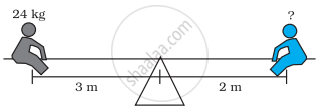
Unequal masses will not balance on a fulcrum if they are at equal distance from it; one side will go up and the other side will go down.
Unequal masses will balance when the following proportion is true:
`("mass"1)/("length"2) = ("mass"2)/("length"1)`

Two children can be balanced on a seesaw when
`("mass"1)/("length"2) = ("mass"2)/("length"1)`. The child on the left and child on the right are balanced. What is the mass of the child on the right?