Advertisements
Advertisements
प्रश्न
Find the intervals on which the function f(x) = (x – 1)3 (x – 2)2 is (a) strictly increasing (b) strictly decreasing.
Advertisements
उत्तर
Given, f(x) = (x – 1)3 (x – 2)2
On differentiating both sides w.r.t. x, we get
f'(x) = `(x - 1)^3 . d/dx (x - 2)^2 + (x - 2)^2 . d/dx (x - 1)^3` ...`[∵ d/dx (uv) = u (dv)/(dx) + v (du)/(dx)]`
f'(x) = (x – 1)3 . 2(x – 2) + (x – 2)2 . 3(x – 1)2
= (x – 1)2 (x – 2) [2(x – 1) + 3(x – 2)]
= (x – 1)2 (x – 2) (2x – 2 + 3x – 6)
or, f'(x) = (x – 1)2 (x – 2) (5x – 8)
Now, put f'(x) = 0
or, (x – 1)2 (x – 2) (5x – 8) = 0
Either (x – 1)2 = 0 or x – 2 = 0 or 5x – 8 = 0
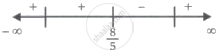
∴ `x = 1, 8/5, 2`
Now, we find intervals and check in which interval f(x) is strictly increasing and strictly decreasing.
| Interval | f'(x) = (x – 1)2 (x – 2) (5x – 8) |
Sign of f'(x) |
| x < 1 | (+)(–)(–) | + ve |
| `1 < x < 8/5` | (+)(–)(–) | + ve |
| `8/5 < x < 2` | (+)(–)(+) | – ve |
| x > 2 | (+)(+)(+) | + ve |
We know that, a functionf(x) is said to be an strictly increasing function, if f'(x) > 0 and strictly decreasing if f'(x) < 0. So, the given function f(x) is increasing on the intervals `(- ∞, 1) (1, 8/5)` or (2, ∞) and decreasing on `(8/5, 2)`.
Since, f(x) is a polynomial function, so it is continuous at `x = 1, 8/5, 2`. Hence, f(x) is
(a) Increasing on intervals `(- ∞, 8/5) ∪ [2, ∞)`
(b) Decreasing on interval `(8/5, 2)`
