Advertisements
Advertisements
प्रश्न
Find the equation of the circle with centre on the X-axis and passing through the origin having radius 4.
Advertisements
उत्तर
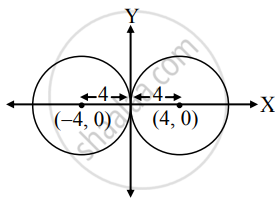
Let the co-ordinates of the centre of the required circle be C(h, 0).
Since the circle passes through the origin i.e., O(0,0),
OC = radius
∴ `sqrt(("h" - 0)^2 + (0 - 0)^2` = 4
∴ h2 = 16
∴ h = ± 4
∴ the co-ordinates of the centre are (4, 0) or (– 4, 0).
The equation of a circle with centre at (h, k) and radius r is given by
(x – h)2 + (y – k)2 = r2
Here, h = ± 4, k = 0, r = 4
∴ The required equation of the circle is
(x – 4)2 + (y – 0)2 = 42 or (x + 4)2 + (y – 0)2 = 42
∴ x2 – 8x + 16 + y2 = 16 or x2 + 8x + 16 + y2 = 16
∴ x2 + y2 – 8x = 0 or x2 + y2 + 8x = 0
APPEARS IN
संबंधित प्रश्न
Find the equation of the circle with centre at origin and radius 4.
Find the equation of the circle with centre at (2, −3) and radius 5.
Find the centre and radius of the circle:
x2 + y2 = 25
Find the centre and radius of the circle:
(x − 5)2 + (y − 3)2 = 20
Find the centre and radius of the circle:
`(x - 1/2)^2 + (y + 1/3)^2 = 1/36`
Find the equation of the circle with centre at (a, b) touching the Y-axis
Find the equation of the circle with centre at (–2, 3) touching the X-axis.
Find the equation of the circle with centre at (3,1) and touching the line 8x − 15y + 25 = 0
Find the equation circle if the equations of two diameters are 2x + y = 6 and 3x + 2y = 4. When radius of circle is 9
If y = 2x is a chord of circle x2 + y2−10x = 0, find the equation of circle with this chord as diametre
Find the equation of a circle passing through the points (1,−4), (5,2) and having its centre on the line x − 2y + 9 = 0
Find the centre and radius of the following:
x2 + y2 − 6x − 8y − 24 = 0
Show that the equation 3x2 + 3y2 + 12x + 18y − 11 = 0 represents a circle
Choose the correct alternative:
If the lines 2x − 3y = 5 and 3x − 4y = 7 are the diameters of a circle of area 154 sq. units, then find the equation of the circle
Choose the correct alternative:
Find the equation of the circle which passes through the points (2, 3) and (4, 5) and the centre lies on the straight line y − 4x + 3 = 0
Choose the correct alternative:
Area of the circle centre at (1, 2) and passing through (4, 6) is
Answer the following :
Find the centre and radius of the circle x2 + y2 − x +2y − 3 = 0
Answer the following :
Find the equation of circle passing through the point of intersection of the lines x + 3y = 0 and 2x − 7y = 0 whose centre is the point of intersection of lines x + y + 1 = 0 and x − 2y + 4 = 0
Answer the following :
Show that the points (9, 1), (7, 9), (−2, 12) and (6, 10) are concyclic
The line 2x − y + 6 = 0 meets the circle x2 + y2 + 10x + 9 = 0 at A and B. Find the equation of circle on AB as diameter.
Answer the following :
Find the equation of the circle concentric with x2 + y2 – 4x + 6y = 1 and having radius 4 units
Answer the following :
Show that the circles touch each other externally. Find their point of contact and the equation of their common tangent:
x2 + y2 – 4x + 10y +20 = 0,
x2 + y2 + 8x – 6y – 24 = 0.
Answer the following :
Show that the circles touch each other externally. Find their point of contact and the equation of their common tangent:
x2 + y2 – 4x – 10y + 19 = 0,
x2 + y2 + 2x + 8y – 23 = 0.
Answer the following :
Show that the circles touch each other internally. Find their point of contact and the equation of their common tangent:
x2 + y2 – 4x – 4y – 28 = 0,
x2 + y2 – 4x – 12 = 0
If one of the diameters of the curve x2 + y2 - 4x - 6y + 9 = 0 is a chord of a circle with centre (1, 1), then the radius of this circle is ______
The centre of the circle x = 3 + 5 cos θ, y = - 4 + 5 sin θ, is ______
The radius of a circle is increasing uniformly at the rate of 2.5cm/sec. The rate of increase in the area when the radius is 12cm, will be ______
If x2 + (2h - 1)xy + y2 - 24x - 8y + k = 0 is the equation of the circle and 12 is the radius of the circle, then ______.
The equation of the circle with centre (4, 5) which passes through (7, 3) is ______.
The equation of circle whose diameter is the line joining the points (–5, 3) and (13, –3) is ______.
Circle x2 + y2 – 4x = 0 touches ______.
Let AB be a chord of the circle x2 + y2 = r2 subtending a right angle at the centre, then the locus of the centroid of the ΔPAB as P moves on the circle is ______.
