Advertisements
Advertisements
प्रश्न
Find the diameter of a circle whose circumference is equal to the sum of circumference of circles with radius 10 cm, 12 cm, and 18 cm.
Advertisements
उत्तर
Let the radius of the circle = R cm
∴ 2πR = 2π × 10 + 2π × 12 + 2π × 18
On dividing each term by 2π, we get:
R = 10 + 12 + 18 = 40 cm
∴ Radius of the circle obtained = 40 cm
And, its diameter = 2 × Radius
= 2 × 40 cm = 80 cm
APPEARS IN
संबंधित प्रश्न
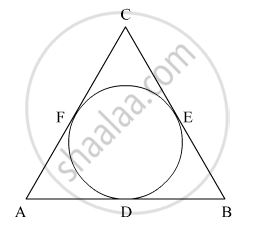
In Fig. 2, a circle is inscribed in a ΔABC, such that it touches the sides AB, BC and CA at points D, E and F respectively. If the lengths of sides AB, BC and CA and 12 cm, 8 cm and 10 cm respectively, find the lengths of AD, BE and CF.
In circle of radius 6cm, chord of length 10 cm makes an angle of 110° at the centre of circle find Circumference of the circle
A wire is in the form of a circle of radius 42 cm. It is bent into a square.
Determine the side of the square and compare the area of the regions enclosed in two cases.
Find the area grazed by a horse tied with a 11. 2 m rope to a corner of a field measuring 25m by 15 m.
Find the area and perimeter of the following sector :
Radius= 6 cm, angle at the centre is 70°
The circumference of a circle is eigth time the circumference of the circle with a radius of 12 cm. Find its diameter.
The circumferences of two circles are in the ratio 5: 7, find the ratio between their radius.
The diameter of the bullock cart wheel is 1.4 m. Find the distance covered by it in 150 rotations?
The area of a circular playground is 22176 m2. Find the cost of fencing this ground at the rate of Rs 50 per metre.
A wire is bent to form a square of side 22 cm. If the wire is rebent to form a circle, its radius is ______.
