Advertisements
Advertisements
प्रश्न
Find the diameter of a circle whose circumference is equal to the sum of circumference of circles with radius 10 cm, 12 cm, and 18 cm.
Advertisements
उत्तर
Let the radius of the circle = R cm
∴ 2πR = 2π × 10 + 2π × 12 + 2π × 18
On dividing each term by 2π, we get:
R = 10 + 12 + 18 = 40 cm
∴ Radius of the circle obtained = 40 cm
And, its diameter = 2 × Radius
= 2 × 40 cm = 80 cm
APPEARS IN
संबंधित प्रश्न
Figure, shows a sector of a circle, centre O, containing an angle θ°. Prove that perimeter of the shaded region is `r(tan θ + sec θ + (πtheta)/180^circ - 1)`.

Choose the correct alternative answer for the following question.
Find the length of the arc of a circle of diameter 42 cm which subtends an angle of 60° at the centre.
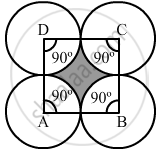
Four equal circles are described about the four corners of a square so that each touches two of the others, as shown in the figure. Find the area of the shaded region, if each side of the square measures 14 cm.
The radius of a circular garden is 100 m. There is a road 10 m wide, running all around it. Find the area of the road and the cost of levelling it at Rs 20 per m2. [Use π = 3.14.]
Find the area and perimeter of the following semi-circle :
Diameter= 5.6 cm
A hollow metallic cylindrical tube has an internal radius of 3.5 cm and height 21 cm. The thickness of the metal tube is 0.5 cm. The tube is melted and cast into a right circular cone of height 7 cm. Find the radius of the cone, correct to one decimal place.
If the circumference of a circle is 352 metres, then its area in square metres is ____________.
The area of a semicircle of radius 4r is ______.
Circumference ‘C’ of a circle can be found by multiplying diameter ‘d’ with ______.
