Advertisements
Advertisements
प्रश्न
Find the area of the triangle formed by the points
(1, – 1), (– 4, 6) and (– 3, – 5)
Advertisements
उत्तर
Let the vertices A(1, – 1), B(– 4, 6) and C(– 3, – 5)
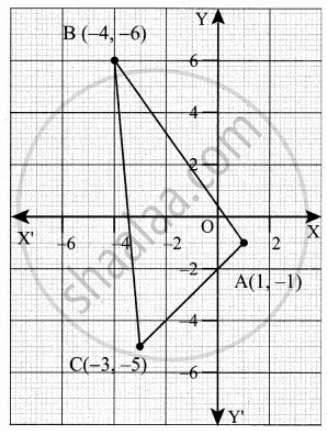
Area of ∆ABC = `1/2 [(x_1y_2 + x_2y_3 + x_3y_1) - (x_2y_1 + x_3y_2 + x_1y_3)]`
= `1/2[((-4 xx - 5) + (-3 xx - 1) + (1 xx 6)),(-(-3 xx 6) + (1 xx -5) + (- 4 xx - 1))]`
= `1/2[(6 + 20 + 3) - (4 - 18 - 5)]`
= `1/2[29 - (- 19)]`
= `1/2[29 + 19]`
= `1/2 xx 48`
= 24 sq. units
Area of ∆ABC = 24 sq. units
APPEARS IN
संबंधित प्रश्न
A triangle and a parallelogram have the same base and the same area. If the sides of the triangle are 13 cm, 14 cm and 15 cm and the parallelogram stands on the base 14 cm, find the height of the parallelogram.
Find the area of the triangle formed by the points
(–10, –4), (–8, –1) and (–3, –5)
Determine whether the sets of points are collinear?
`(-1/2, 3), (-5, 6) and (-8, 8)`
The area of triangle formed by the points (− 5, 0), (0, – 5) and (5, 0) is
The area of a triangle is 5 sq. units. Two of its vertices are (2, 1) and (3, −2). The third vertex is (x, y) where y = x + 3. Find the coordinates of the third vertex.
The area of the isosceles triangle is `5/4 sqrt(11)` cm2, if the perimeter is 11 cm and the base is 5 cm.
The triangular side walls of a flyover have been used for advertisements. The sides of the walls are 13 m, 14 m and 15 m. The advertisements yield an earning of Rs 2000 per m2 a year. A company hired one of its walls for 6 months. How much rent did it pay?
From a point in the interior of an equilateral triangle, perpendiculars are drawn on the three sides. The lengths of the perpendiculars are 14 cm, 10 cm and 6 cm. Find the area of the triangle.
The perimeter of an isosceles triangle is 32 cm. The ratio of the equal side to its base is 3 : 2. Find the area of the triangle.
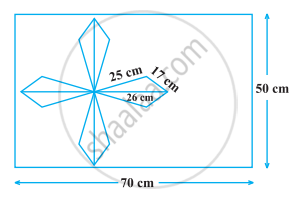
A design is made on a rectangular tile of dimensions 50 cm × 70 cm as shown in the following figure. The design shows 8 triangles, each of sides 26 cm, 17 cm and 25 cm. Find the total area of the design and the remaining area of the tile.