मराठी

Find the Area of the Region Bounded by the Curves (X -1)2 + Y2 = 1 and X2 + Y2 = 1, Using Integration. - Mathematics

Advertisements
Advertisements

प्रश्न

Find the area of the region bounded by the curves (x -1)2 + y2 = 1 and x2 + y2 = 1, using integration.

बेरीज
Advertisements

उत्तर

The area bounded by the curves, (x – 1)2 + y2 = 1 and x2 + y 2 = 1, is represented by the shaded area as
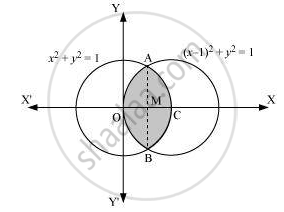
On solving the equations, (x – 1)2 + y2 = 1 and x2 + y 2 = 1, we obtain the point of intersection as A`(1/2, sqrt3/2) and B(1/2, -sqrt3/2)`

It can be observed that the required area is symmetrical about x-axis.
∴ Area OBCAO = 2 × Area OCAO
We join AB, which intersects OC at M, such that AM is perpendicular to OC.
The coordinates of M are `(1/2, 0)`.

⇒ Area OCAD = Area OMAO + Area MCAM

= `[ int_0^(1/2) sqrt(1 - (x - 1)^2) dx + int_(1/2)^1 sqrt(1 - x^2 ) dx ]`

= `[ (x -1)/2 sqrt(1 - (x - 1)^2) + 1/2 sin^-1(x -1)]_0^(1/2) + [ x/2 sqrt(1 - x)^2 + 1/2 sin^-1 x]_(1/2)^1`

= `[ - 1/4 sqrt( 1 - (-1/2)^2) + 1/2 sin^-1(1/2 - 1) - 1/2 sin^-1 (-1)] + [1/2 sin^-1 - 1/4 sqrt(1 - (1/2)^2) - 1/2sin^-1 (1/2)]`

= `[- sqrt3/8 + 1/2(- pi/6) - 1/2 (- pi/2)] + [1/2(pi/2) - sqrt3/8 - 1/2(pi/6)]`

= `[-sqrt3/4 - pi/12 + pi/4 + pi/4 - pi/12 ]`

= `[-sqrt3/4 - pi/6 + pi/2]`

= `[2pi/6 - sqrt3/4]`

Therefore, required area OBCAO = `2 xx (2pi/6 - sqrt3/4 ) = (2pi/3 - sqrt3/2)` units

shaalaa.com
  या प्रश्नात किंवा उत्तरात काही त्रुटी आहे का?
2018-2019 (March) 65/3/1

संबंधित प्रश्‍न

Form the differential equation of the family of hyperbolas having foci on x-axis and centre at origin.


For the curve y = 5x – 2x3, if x increases at the rate of 2 units/sec, then find the rate of change of the slope of the curve when x = 3


Show that the family of curves for which `dy/dx = (x^2+y^2)/(2x^2)` is given by  x2 - y2 = cx


Form the differential equation from the following primitive where constants are arbitrary:
y = cx + 2c2 + c3


Form the differential equation from the following primitive where constants are arbitrary:
xy = a2


Find the differential equation of the family of curves, x = A cos nt + B sin nt, where A and B are arbitrary constants.


Form the differential equation corresponding to y2 − 2ay + x2 = a2 by eliminating a.


Form the differential equation corresponding to (x − a)2 + (y − b)2 = r2 by eliminating a and b.


Represent the following families of curves by forming the corresponding differential equations (a, b being parameters):
x2 + y2 = a2


Represent the following families of curves by forming the corresponding differential equations (a, b being parameters):
y2 = 4ax


Represent the following families of curves by forming the corresponding differential equations (a, b being parameters):
y = ax3


Find the equation of a curve passing through the point (0, 0) and whose differential equation is \[\frac{dy}{dx} = e^x \sin x\]


Find one-parameter families of solution curves of the following differential equation:-

\[x\frac{dy}{dx} + y = x^4\]


Find one-parameter families of solution curves of the following differential equation:-

\[\left( x \log x \right)\frac{dy}{dx} + y = \log x\]


Find one-parameter families of solution curves of the following differential equation:-

\[\frac{dy}{dx} + y \cos x = e^{\sin x} \cos x\]


Write the order of the differential equation representing the family of curves y = ax + a3.


The differential equation which represents the family of curves y = eCx is


Form the differential equation representing the family of curves y = mx, where m is an arbitrary constant.


Form the differential equation of the family of ellipses having foci on y-axis and centre at the origin.


Find the differential equation of the family of curves y = Ae2x + B.e–2x.


Find the equation of a curve passing through the point (1, 1) if the perpendicular distance of the origin from the normal at any point P(x, y) of the curve is equal to the distance of P from the x-axis.


Find the equation of a curve passing through origin and satisfying the differential equation `(1 + x^2) "dy"/"dx" + 2xy` = 4x2 


Find the equation of a curve passing through origin if the slope of the tangent to the curve at any point (x, y) is equal to the square of the difference of the abcissa and ordinate of the point.


The differential equation `y ("d"y)/("d"x) + "c"` represents: ______.


The curve for which the slope of the tangent at any point is equal to the ratio of the abcissa to the ordinate of the point is ______.


Differential equation representing the family of curves y = ex (Acosx + Bsinx) is `("d"^2y)/("d"x^2) - 2 ("d"y)/("d"x) + 2y` = 0


Share
Notifications

Englishहिंदीमराठी


      Forgot password?
Use app×