मराठी

Find the area bounded by the lines y = 4x + 5, y = 5 – x and 4y = x + 5. - Mathematics

Advertisements
Advertisements

प्रश्न

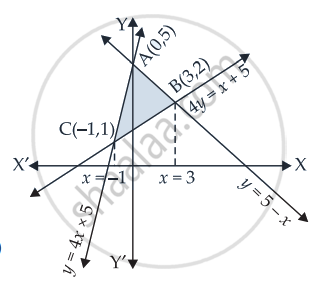
Find the area bounded by the lines y = 4x + 5, y = 5 – x and 4y = x + 5.

बेरीज
Advertisements

उत्तर


Given that y = 4x + 5  .....(i)

y = 5 – x  ......(ii)

And 4y = x + 5  ......(iii)

x 0 `-5/4`
y 5 0


x 0 5
y 5 0


x 0 –5
y `5/4` 0

Solving equations (i) and (ii)

We get 4x + 5 = 5 – x

⇒ x = 0 and y = 5

∴ Coordinates of A = (0, 5)

Solving equations (ii) and (iii)

y = 5 – x

4y = x + 5

5y = 10

∴ y = 2 and x = 3

∴ Coordinates of B = (3, 2)

Solving equations (i) and (iii)

y = 4x + 5

4y = x + 5

⇒ 4(4x + 5) = x + 5

⇒ 16x + 20 = x + 5

⇒ 15x = – 15

∴ x = –1 and y = 1

∴ Coordinates of C = (–1, 1).

∴ Area of required regions = `int_(-1)^0 y_"AC" "d"x + int_0^3 y_"AB" "d"x - int_(-1)^3 y_"CB" "d"x`

= `int_(-1)^0 (4x + 5) "d"x + int_0^3 (5 - x) "d"x - int_(-1)^3 (x + 5)/4 "d"x`

= `[4  x^2/2 + 5x]_-1^0 + [5x - x^2/2]_0^3 - 1/4[x^2/2 + 5x]_-1^3`

= `[(0 + 0) - (2 - 5)] + [(15 - 9/2) - (0 - 0)] - 1/4[(9/2 + 15) - (1/2 - 5)]`

= `3 + 21/2 - 1/4[39/2 + 9/2]`

= `3 + 21/2 - 1/4 xx 24`

⇒ `3 + 21/2 - 6`

= `15/2` sq.units

Hence, the required area =  `15/2` sq.units

shaalaa.com
  या प्रश्नात किंवा उत्तरात काही त्रुटी आहे का?
पाठ 8: Application Of Integrals - Exercise [पृष्ठ १७७]

APPEARS IN

एनसीईआरटी एक्झांप्लर Mathematics [English] Class 12
पाठ 8 Application Of Integrals
Exercise | Q 21 | पृष्ठ १७७

व्हिडिओ ट्यूटोरियलVIEW ALL [1]

संबंधित प्रश्‍न

Find the area bounded by the curve y2 = 4axx-axis and the lines x = 0 and x = a.


Find the area of the region bounded by the curve y = sinx, the lines x=-π/2 , x=π/2 and X-axis


Using integration, find the area of the region bounded by the lines y = 2 + x, y = 2 – x and x = 2.


Sketch the region bounded by the curves `y=sqrt(5-x^2)` and y=|x-1| and find its area using integration.


Using integration, find the area of the region bounded between the line x = 2 and the parabola y2 = 8x.


Find the area under the curve y = \[\sqrt{6x + 4}\] above x-axis from x = 0 to x = 2. Draw a sketch of curve also.


Sketch the region {(x, y) : 9x2 + 4y2 = 36} and find the area of the region enclosed by it, using integration.


Draw a rough sketch of the curve \[y = \frac{x}{\pi} + 2 \sin^2 x\] and find the area between the x-axis, the curve and the ordinates x = 0 and x = π.


Find the area of the region bounded by the curves y = x − 1 and (y − 1)2 = 4 (x + 1).


Find the area of the circle x2 + y2 = 16 which is exterior to the parabola y2 = 6x.


Make a sketch of the region {(x, y) : 0 ≤ y ≤ x2 + 3; 0 ≤ y ≤ 2x + 3; 0 ≤ x ≤ 3} and find its area using integration.


Find the area of the figure bounded by the curves y = | x − 1 | and y = 3 −| x |.


Find the area of the region between the parabola x = 4y − y2 and the line x = 2y − 3.


The area of the region formed by x2 + y2 − 6x − 4y + 12 ≤ 0, y ≤ x and x ≤ 5/2 is ______ .


The ratio of the areas between the curves y = cos x and y = cos 2x and x-axis from x = 0 to x = π/3 is ________ .


Area bounded by parabola y2 = x and straight line 2y = x is _________ .


The area of the region (in square units) bounded by the curve x2 = 4y, line x = 2 and x-axis is


The area bounded by the curve y2 = 8x and x2 = 8y is ___________ .


The area bounded by the curve y = x |x| and the ordinates x = −1 and x = 1 is given by


Find the area bounded by the parabola y2 = 4x and the line y = 2x − 4 By using vertical strips.


Find the equation of the parabola with latus-rectum joining points (4, 6) and (4, -2).


Sketch the graphs of the curves y2 = x and y2 = 4 – 3x and find the area enclosed between them. 


Find the area of the region above the x-axis, included between the parabola y2 = ax and the circle x2 + y2 = 2ax.


Find the area of the region bounded by the curve y = x3 and y = x + 6 and x = 0


Find the area of the region enclosed by the parabola x2 = y and the line y = x + 2


Find the area of the region bounded by y = `sqrt(x)` and y = x.


Draw a rough sketch of the given curve y = 1 + |x +1|, x = –3, x = 3, y = 0 and find the area of the region bounded by them, using integration.


The area of the region bounded by the curve x2 = 4y and the straight line x = 4y – 2 is ______.


Area of the region bounded by the curve y = cosx between x = 0 and x = π is ______.


The area of the region bounded by the curve x = 2y + 3 and the y lines. y = 1 and y = –1 is ______.


Find the area of the region bounded by the curve `y^2 - x` and the line `x` = 1, `x` = 4 and the `x`-axis.


What is the area of the region bounded by the curve `y^2 = 4x` and the line `x` = 3.


The area bounded by `y`-axis, `y = cosx` and `y = sinx, 0  ≤ x - (<pi)/2` is


Make a rough sketch of the region {(x, y): 0 ≤ y ≤ x2, 0 ≤ y ≤ x, 0 ≤ x ≤ 2} and find the area of the region using integration.


Let the curve y = y(x) be the solution of the differential equation, `("dy")/("d"x) = 2(x + 1)`. If the numerical value of area bounded by the curve y = y(x) and x-axis is `(4sqrt(8))/3`, then the value of y(1) is equal to ______.


The area (in sq.units) of the region A = {(x, y) ∈ R × R/0 ≤ x ≤ 3, 0 ≤ y ≤ 4, y ≤x2 + 3x} is ______.


The area (in square units) of the region bounded by the curves y + 2x2 = 0 and y + 3x2 = 1, is equal to ______.


Evaluate:

`int_0^1x^2dx`


Share
Notifications

Englishहिंदीमराठी


      Forgot password?
Use app×