Advertisements
Advertisements
प्रश्न
Find the ratio of the lengths of an iron rod and an aluminium rod for which the difference in the lengths is independent of temperature. Coefficients of linear expansion of iron and aluminium are 12 × 10–6 °C–1 and 23 × 10–6 °C–1 respectively.
Advertisements
उत्तर
Let the original length of iron rod be LFe and L'Fe be its length when temperature is increased by ΔT.
Let the original length of aluminium rod be LAl and L'Al be its length when temperature is increased by ΔT.
Coefficient of linear expansion of iron,
\[\alpha_{Fe}\] = 12 × 10–6 °C
\[-\] 1
Coefficient of linear expansion of aluminium, αAl = 23 × 10–6 °C
\[-\] 1
Since the difference in length is independent of temperature, the difference is always constant.
\[L '_{Fe} = L_{Fe} \left( 1 + \alpha_{Fe} \times ∆ T \right)\]
\[and\] \[ L '_{Al} = L_{Al} \left( 1 + \alpha_{Al} \times ∆ T \right)\]
\[ \Rightarrow \begin{array}\[L '_{Fe} - L '_{Al} = L_{Fe} - L_{Al} + L_{Fe} \times \alpha_{Fe} ∆ T - L_{Al} \times \alpha_{Al} \times ∆ T & - (1)\end{array}\]
\[Given: \]
\[L '_{Fe} - L '_{Al} = L_{Fe} - L_{Al} \]
\[Hence, L_{Fe} \alpha_{Fe} = L_{Al} \alpha_{Al} [using (1)]\]
\[ \Rightarrow \frac{L_{Fe}}{L_{Al}} = \frac{23}{12}\]
The ratio of the lengths of the iron to the aluminium rod is 23:12.
APPEARS IN
संबंधित प्रश्न
A tightly closed metal lid of a glass bottle can be opened more easily if it is put in hot water for some time. Explain.
A metal sheet with a circular hole is heated. The hole
An aluminium plate fixed in a horizontal position has a hole of diameter 2.000 cm. A steel sphere of diameter 2.005 cm rests on this hole. All the lengths refer to a temperature of 10 °C. The temperature of the entire system is slowly increased. At what temperature will the ball fall down? Coefficient of linear expansion of aluminium is 23 × 10–6 °C–1 and that of steel is 11 × 10–6 °C–1.
A glass window is to be fit in an aluminium frame. The temperature on the working day is 40°C and the glass window measures exactly 20 cm × 30 cm. What should be the size of the aluminium frame so that there is no stress on the glass in winter even if the temperature drops to 0°C? Coefficients of linear expansion for glass and aluminium are 9.0 × 10⁻⁶ °C–1 and 24 ×100–6°C–1 , respectively.
One end of a steel rod (K = 46 J s−1 m−1°C−1) of length 1.0 m is kept in ice at 0°C and the other end is kept in boiling water at 100°C. The area of cross section of the rod is 0.04 cm2. Assuming no heat loss to the atmosphere, find the mass of the ice melting per second. Latent heat of fusion of ice = 3.36 × 10⁵ J kg−1.
A steel frame (K = 45 W m−1°C−1) of total length 60 cm and cross sectional area 0.20 cm2, forms three sides of a square. The free ends are maintained at 20°C and 40°C. Find the rate of heat flow through a cross section of the frame.
Steam at 120°C is continuously passed through a 50 cm long rubber tube of inner and outer radii 1.0 cm and 1.2 cm. The room temperature is 30°C. Calculate the rate of heat flow through the walls of the tube. Thermal conductivity of rubber = 0.15 J s−1 m−1°C−1.
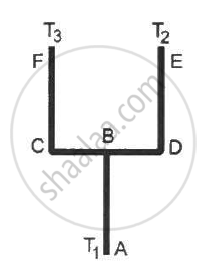
Four identical rods AB, CD, CF and DE are joined as shown in following figure . The length, cross-sectional area and thermal conductivity of each rod are l, A and K respectively. The ends A, E and F are maintained at temperature T1, T2 and T3 respectively. Assuming no loss of heat to the atmosphere, find the temperature at B.
There are two identical vessels filled with equal amounts of ice. The vessels are of different metals. If the ice melts in the two vessels in 20 and 35 minutes respectively, the ratio of the coefficients of thermal conductivity of the two metals is:
The coefficient of thermal conductivity depends upon ______.
Heat is associated with ______.
A thin rod having length L0 at 0°C and coefficient of linear expansion α has its two ends maintained at temperatures θ1 and θ2, respectively. Find its new length.
In conduction, how does heat mainly travel through a solid rod kept with one end in a flame?
Which of the following is a correct example of a bad conductor of heat used in daily life to reduce heat loss or gain?
At the molecular level, how is heat transferred in a solid during conduction?
During conduction along a metal rod, which part becomes hot first, and why?
