Advertisements
Advertisements
प्रश्न
Find the equation of the plane passing through the line of intersection of the planes `vecr.(hati + hatj + hatk) = 1` and `vecr.(2hati + 3hatj -hatk) + 4 = 0` and parallel to x-axis.
Advertisements
उत्तर
The given planes are
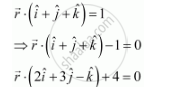
The equation of any plane passing through the line of intersection of these planes is
r→.i⏜+j⏜+k⏜-1+λr→.2i⏜+3j⏜-k⏜+4=0
r→.2λ+1i⏜+3λ+1j⏜+1-λk⏜+4λ-1=0 ...(1)
Its direction ratios are (2λ + 1), (3λ + 1), and (1 − λ).
The required plane is parallel to x-axis. Therefore, its normal is perpendicular to x-axis.
The direction ratios of x-axis are 1, 0, and 0.

Therefore, its Cartesian equation is y − 3z + 6 = 0
This is the equation of the required plane.
APPEARS IN
संबंधित प्रश्न
Find the vector equation of the plane passing through the intersection of the planes `vecr.(2hati + 2hatj - 3hatk) = 7, vecr.(2hati + 5hatj + 3hatk) = 9` and through the point (2, 1, 3)
Find the equation of the plane which contains the line of intersection of the planes `vecrr.(hati + 2hatj + 3hatk) - 4 = 0, vecr.(2hati + htj - hatk) + 5 = 0`, and which is perpendicular to the plane `vecr.(5hati + 3hatj - 6hatk) + 8 = 0`.
Find the coordinates of the point where the line \[\frac{x - 2}{3} = \frac{y + 1}{4} = \frac{z - 2}{2}\] intersects the plane x − y + z − 5 = 0. Also, find the angle between the line and the plane.
Find the distance of the point (−1, −5, −10) from the point of intersection of the line \[\vec{r} = \left( 2 \hat{i} - \hat{j} + 2 \hat{k} \right) + \lambda\left( 3 \hat{i}+ 4 \hat{j} + 2 \hat{k} \right)\] and the plane \[\vec{r} . \left( \hat{i} - \hat{j} + \hat{k} \right) = 5 .\]
Find the distance of the point (2, 12, 5) from the point of intersection of the line \[\vec{r} = 2 \hat{i} - 4 \hat{j}+ 2 \hat{k} + \lambda\left( 3 \hat{i} + 4 \hat{j} + 2 \hat{k} \right)\] and \[\vec{r} . \left( \hat{i} - 2 \hat{j} + \hat{k} \right) = 0\]
Find the distance of the point P(−1, −5, −10) from the point of intersection of the line joining the points A(2, −1, 2) and B(5, 3, 4) with the plane \[x - y + z = 5\] .
Find the distance of the point P(3, 4, 4) from the point, where the line joining the points A(3, –4, –5) and B(2, –3, 1) intersects the plane 2x + y + z = 7.
Find the equation of the plane containing the line \[\frac{x + 1}{- 3} = \frac{y - 3}{2} = \frac{z + 2}{1}\] and the point (0, 7, −7) and show that the line \[\frac{x}{1} = \frac{y - 7}{- 3} = \frac{z + 7}{2}\] also lies in the same plane.
Find the equation of the plane which contains two parallel lines\[\frac{x - 4}{1} = \frac{y - 3}{- 4} = \frac{z - 2}{5}\text{ and }\frac{x - 3}{1} = \frac{y + 2}{- 4} = \frac{z}{5} .\]
Show that the plane whose vector equation is \[\vec{r} \cdot \left( \hat{i} + 2 \hat{j} - \hat{k} \right) = 3\] contains the line whose vector equation is \[\vec{r} = \hat{i} + \hat{j} + \lambda\left( 2 \hat{i} + \hat{j} + 4 \hat{k} \right) .\]
Find the equation of the plane determined by the intersection of the lines \[\frac{x + 3}{3} = \frac{y}{- 2} = \frac{z - 7}{6} \text{ and }\frac{x + 6}{1} = \frac{y + 5}{- 3} = \frac{z - 1}{2}\]
Find the coordinates of the point where the line \[\frac{x - 2}{3} = \frac{y + 1}{4} = \frac{z - 2}{2}\] intersect the plane x − y + z − 5 = 0. Also, find the angle between the line and the plane.
Find the distance of the point with position vector
The equation of the plane through the intersection of the planes x + 2y + 3z = 4 and 2x + y − z = −5 and perpendicular to the plane 5x + 3y + 6z + 8 = 0 is
The equation of the plane through the line x + y + z + 3 = 0 = 2x − y + 3z + 1 and parallel to the line \[\frac{x}{1} = \frac{y}{2} = \frac{z}{3}\] is
A plane meets the coordinate axes at A, B and C such that the centroid of ∆ABC is the point (a, b, c). If the equation of the plane is \[\frac{x}{a} + \frac{y}{b} + \frac{z}{c} = k,\] then k =
A vector parallel to the line of intersection of the planes\[\vec{r} \cdot \left( 3 \hat{i} - \hat{j} + \hat{k} \right) = 1 \text{ and } \vec{r} \cdot \left( \hat{i} + 4 \hat{j} - 2 \hat{k} \right) = 2\] is
The distance of the point (−1, −5, −10) from the point of intersection of the line \[\vec{r} = 2 \hat{i}- \hat{j} + 2 \hat{k} + \lambda\left( 3 \hat{i} + 4 \hat{j}+ 12 \hat{k} \right)\] and the plane \[\vec{r} \cdot \left( \hat{i} - \hat{j} + \hat{k} \right) = 5\] is
The equation of the plane which cuts equal intercepts of unit length on the coordinate axes is
Find the equation of the plane passing through the intersection of the planes `vecr . (hati + hatj + hatk)` and `vecr.(2hati + 3hatj - hatk) + 4 = 0` and parallel to the x-axis. Hence, find the distance of the plane from the x-axis.
Show that the lines `("x"-1)/(3) = ("y"-1)/(-1) = ("z"+1)/(0) = λ and ("x"-4)/(2) = ("y")/(0) = ("z"+1)/(3)` intersect. Find their point of intersection.
Find the vector equation of the line which is parallel to the vector `3hat"i" - 2hat"j" + 6hat"k"` and which passes through the point (1, –2, 3).
Show that the lines `(x - 1)/2 = (y - 2)/3 = (z - 3)/4` and `(x - 4)/5 = (y - 1)/2` = z intersect. Also, find their point of intersection.
Find the equation of the plane which is perpendicular to the plane 5x + 3y + 6z + 8 = 0 and which contains the line of intersection of the planes x + 2y + 3z – 4 = 0 and 2x + y – z + 5 = 0.
Find the equation of the plane through the intersection of the planes `vec"r" * (hat"i" + 3hat"j") - 6` = 0 and `vec"r" * (3hat"i" - hat"j" - 4hat"k")` = 0, whose perpendicular distance from origin is unity.
Find the equation of line parallel to the y-axis and drawn through the point of intersection of x – 4y + 1 = 0 and 2x + y – 7 = 0.
ABCD be a parallelogram and M be the point of intersection of the diagonals, if O is any point, then OA + OB + OC + OD is equal to
