Advertisements
Advertisements
प्रश्न
Find the coordinates of the point where the line through (3, −4, −5) and (2, − 3, 1) crosses the plane 2x + y + z = 7).
Advertisements
उत्तर
It is known that the equation of the line through the points, (x1, y1, z1) and (x2, y2, z2), is
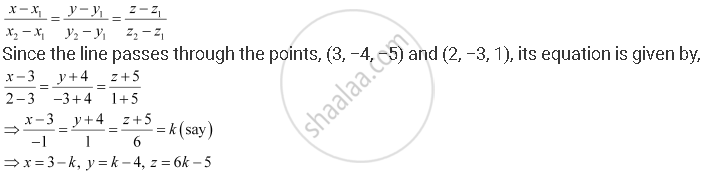
Therefore, any point on the line is of the form (3 − k, k − 4, 6k − 5).
This point lies on the plane, 2x + y + z = 7
∴ 2 (3 − k) + (k − 4) + (6k − 5) = 7
`=> 5k - 3 =7`
`=> k = 2`
Hence, the coordinates of the required point are (3 − 2, 2 − 4, 6 × 2 − 5) i.e.,
(1, −2, 7).
APPEARS IN
संबंधित प्रश्न
In following cases, determine the direction cosines of the normal to the plane and the distance from the origin.
z = 2
In following cases, determine the direction cosines of the normal to the plane and the distance from the origin.
x + y + z = 1
In following cases, determine the direction cosines of the normal to the plane and the distance from the origin.
2x + 3y – z = 5
Find the equation of the plane with intercept 3 on the y-axis and parallel to ZOX plane.
If the coordinates of the points A, B, C, D be (1, 2, 3), (4, 5, 7), (−4, 3, −6) and (2, 9, 2) respectively, then find the angle between the lines AB and CD.
Find the coordinates of the point where the line through (5, 1, 6) and (3, 4, 1) crosses the YZ-plane
Find the coordinates of the point where the line through (5, 1, 6) and (3, 4, 1) crosses the ZX − plane.
The planes: 2x − y + 4z = 5 and 5x − 2.5y + 10z = 6 are
(A) Perpendicular
(B) Parallel
(C) intersect y-axis
(C) passes through `(0,0,5/4)`
Find the equation of the plane passing through the point (2, 3, 1), given that the direction ratios of the normal to the plane are proportional to 5, 3, 2.
If the axes are rectangular and P is the point (2, 3, −1), find the equation of the plane through P at right angles to OP.
Reduce the equation 2x − 3y − 6z = 14 to the normal form and, hence, find the length of the perpendicular from the origin to the plane. Also, find the direction cosines of the normal to the plane.
Reduce the equation \[\vec{r} \cdot \left( \hat{i} - 2 \hat{j} + 2 \hat{k} \right) + 6 = 0\] to normal form and, hence, find the length of the perpendicular from the origin to the plane.
Write the normal form of the equation of the plane 2x − 3y + 6z + 14 = 0.
The direction ratios of the perpendicular from the origin to a plane are 12, −3, 4 and the length of the perpendicular is 5. Find the equation of the plane.
Find a unit normal vector to the plane x + 2y + 3z − 6 = 0.
Find the equation of a plane which is at a distance of \[3\sqrt{3}\] units from the origin and the normal to which is equally inclined to the coordinate axes.
Find the vector equation of the plane which is at a distance of \[\frac{6}{\sqrt{29}}\] from the origin and its normal vector from the origin is \[2 \hat{i} - 3 \hat{j} + 4 \hat{k} .\] Also, find its Cartesian form.
Find the distance of the plane 2x − 3y + 4z − 6 = 0 from the origin.
Find the equation of the plane which contains the line of intersection of the planes \[x + 2y + 3z - 4 = 0 \text { and } 2x + y - z + 5 = 0\] and whose x-intercept is twice its z-intercept.
Prove that the line of section of the planes 5x + 2y − 4z + 2 = 0 and 2x + 8y + 2z − 1 = 0 is parallel to the plane 4x − 2y − 5z − 2 = 0.
Find the value of λ such that the line \[\frac{x - 2}{6} = \frac{y - 1}{\lambda} = \frac{z + 5}{- 4}\] is perpendicular to the plane 3x − y − 2z = 7.
Write the value of k for which the line \[\frac{x - 1}{2} = \frac{y - 1}{3} = \frac{z - 1}{k}\] is perpendicular to the normal to the plane \[\vec{r} \cdot \left( 2 \hat{i} + 3 \hat{j} + 4 \hat{k} \right) = 4 .\]
Write the vector equation of the line passing through the point (1, −2, −3) and normal to the plane \[\vec{r} \cdot \left( 2 \hat{i} + \hat{j} + 2 \hat{k} \right) = 5 .\]
The equation of the plane \[\vec{r} = \hat{i} - \hat{j} + \lambda\left( \hat{i} + \hat{j} + \hat{k} \right) + \mu\left( \hat{i} - 2 \hat{j} + 3 \hat{k} \right)\] in scalar product form is
The equations of x-axis in space are ______.
Find the equation of a plane which is at a distance `3sqrt(3)` units from origin and the normal to which is equally inclined to coordinate axis.
The unit vector normal to the plane x + 2y +3z – 6 = 0 is `1/sqrt(14)hat"i" + 2/sqrt(14)hat"j" + 3/sqrt(14)hat"k"`.
Find the vector equation of a plane which is at a distance of 7 units from the origin and which is normal to the vector `3hati + 5hatj - 6hatk`
In the following cases find the c9ordinates of foot of perpendicular from the origin `2x + 3y + 4z - 12` = 0
