Advertisements
Advertisements
प्रश्न
Find the area of the region bounded by y =\[\sqrt{x}\] and y = x.
Advertisements
उत्तर
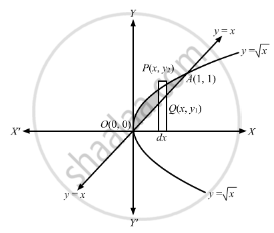
\[y = \sqrt{x} . . . \left( 1 \right)\text{ is a parabola opening side ways, with vertex at O(0, 0) and + ve }x - \text{ axis as axis of symmetry }\]
\[x = y . . . \left( 2 \right)\text{ is a straight line passsing through O(0, 0) and at angle }{45}^o\text{ with the }x - \text{ axis }\]
\[\text{ Solving }\left( 1 \right)\text{ and }\left( 2 \right) \]
\[ y^2 = x = y \]
\[ \Rightarrow y^2 = y \]
\[ \Rightarrow y(y - 1) = 0 \]
\[ \Rightarrow y = 0\text{ or }y = 1\text{ and }x = 0\text{ or }x = 1\]
\[\text{ Thus, the line intersects the parabola at O(0, 0 ) and A(1, 1) }\]
\[\text{ Consider a approximating rectangle of length }= \left| y_2 - y_1 \right|\text{ and width }= dx \]
\[\text{ Area of approximating rectangle }= \left| y_2 - y_1 \right| dx\]
\[\text{ Approximating rectangle moves from }x = 0\text{ to }x = 1 \]
\[ \therefore\text{ Area of the shaded region }= \int_0^1 \left| y_2 - y_1 \right| dx = \int_0^1 \left( y_2 - y_1 \right) dx ...............\left[ As, y_2 > y_1 , \left| y_2 - y_1 \right| = y_2 - y_1 \right] \]
\[ \Rightarrow A = \int_0^1 \left( \sqrt{x} - x \right) dx \]
\[ \Rightarrow A = \left[ \frac{x^\frac{3}{2}}{\frac{3}{2}} - \frac{x^2}{2} \right]_0^1 \]
\[ \Rightarrow A = \left[ \frac{1^\frac{3}{2}}{\frac{3}{2}} - \frac{1^2}{2} - 0 \right]\]
\[ \Rightarrow A = \frac{2}{3} - \frac{1}{2} = \frac{1}{6}\text{ sq . units }\]
\[ \therefore\text{ Area bound by the parabola and straight line }= \frac{1}{6}\text{ sq . units }\]
APPEARS IN
संबंधित प्रश्न
Find the equation of a curve passing through the point (0, 2), given that the sum of the coordinates of any point on the curve exceeds the slope of the tangent to the curve at that point by 5.
Draw a rough sketch of the graph of the curve \[\frac{x^2}{4} + \frac{y^2}{9} = 1\] and evaluate the area of the region under the curve and above the x-axis.
Sketch the region {(x, y) : 9x2 + 4y2 = 36} and find the area of the region enclosed by it, using integration.
Using integration, find the area of the region bounded by the line 2y = 5x + 7, x-axis and the lines x = 2 and x = 8.
Find the area of the region bounded by the curve xy − 3x − 2y − 10 = 0, x-axis and the lines x = 3, x = 4.
Find the area bounded by the curve y = cos x, x-axis and the ordinates x = 0 and x = 2π.
Show that the areas under the curves y = sin x and y = sin 2x between x = 0 and x =\[\frac{\pi}{3}\] are in the ratio 2 : 3.
Find the area of the region common to the parabolas 4y2 = 9x and 3x2 = 16y.
Find the area of the region common to the circle x2 + y2 = 16 and the parabola y2 = 6x.
Find the area, lying above x-axis and included between the circle x2 + y2 = 8x and the parabola y2 = 4x.
Using integration, find the area of the triangle ABC coordinates of whose vertices are A (4, 1), B (6, 6) and C (8, 4).
Find the area of the circle x2 + y2 = 16 which is exterior to the parabola y2 = 6x.
Find the area of the region enclosed between the two curves x2 + y2 = 9 and (x − 3)2 + y2 = 9.
Find the area of the region {(x, y): x2 + y2 ≤ 4, x + y ≥ 2}.
Find the area of the figure bounded by the curves y = | x − 1 | and y = 3 −| x |.
Find the area bounded by the parabola y2 = 4x and the line y = 2x − 4 By using horizontal strips.
The area bounded by the parabola y2 = 4ax, latusrectum and x-axis is ___________ .
The area of the region bounded by the parabola y = x2 + 1 and the straight line x + y = 3 is given by
Area bounded by parabola y2 = x and straight line 2y = x is _________ .
Find the area bounded by the parabola y2 = 4x and the line y = 2x − 4 By using vertical strips.
Find the equation of the parabola with latus-rectum joining points (4, 6) and (4, -2).
Find the area of the curve y = sin x between 0 and π.
Find the area of the region bounded by the curves y2 = 9x, y = 3x
Find the area of the region enclosed by the parabola x2 = y and the line y = x + 2
Find the area enclosed by the curve y = –x2 and the straight lilne x + y + 2 = 0
Area of the region bounded by the curve y = cosx between x = 0 and x = π is ______.
The area of the region bounded by the circle x2 + y2 = 1 is ______.
The region bounded by the curves `x = 1/2, x = 2, y = log x` and `y = 2^x`, then the area of this region, is
What is the area of the region bounded by the curve `y^2 = 4x` and the line `x` = 3.
Smaller area bounded by the circle `x^2 + y^2 = 4` and the line `x + y = 2` is.
Let T be the tangent to the ellipse E: x2 + 4y2 = 5 at the point P(1, 1). If the area of the region bounded by the tangent T, ellipse E, lines x = 1 and x = `sqrt(5)` is `sqrt(5)`α + β + γ `cos^-1(1/sqrt(5))`, then |α + β + γ| is equal to ______.
The area of the region S = {(x, y): 3x2 ≤ 4y ≤ 6x + 24} is ______.
Let P(x) be a real polynomial of degree 3 which vanishes at x = –3. Let P(x) have local minima at x = 1, local maxima at x = –1 and `int_-1^1 P(x)dx` = 18, then the sum of all the coefficients of the polynomial P(x) is equal to ______.
The area (in square units) of the region bounded by the curves y + 2x2 = 0 and y + 3x2 = 1, is equal to ______.
Find the area of the smaller region bounded by the curves `x^2/25 + y^2/16` = 1 and `x/5 + y/4` = 1, using integration.
Make a rough sketch of the region {(x, y) : 0 ≤ y ≤ x2 + 1, 0 ≤ y ≤ x + 1, 0 ≤ x ≤ 2} and find the area of the region, using the method of integration.
