Advertisements
Advertisements
प्रश्न
Find the area enclosed by the curves y = | x − 1 | and y = −| x − 1 | + 1.
Advertisements
उत्तर
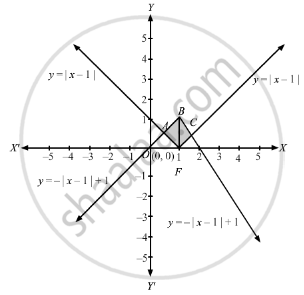
The given curves are \[y = \left| x - 1 \right| . . . . . \left( 1 \right)\]
\[y = - \left| x - 1 \right| + 1 . . . . . \left( 2 \right)\]
Clearly \[y = \left| x - 1 \right|\] is cutting the x-axis at (1, 0) and the y-axis at (0, 1) respectively.
Also \[y = - \left| x - 1 \right| + 1\] is cutting both the axes at (0, 0) and x-axis at (2, 0).
We have,
\[y = \left| x - 1 \right|\]
\[y = \begin{cases}x - 1& x \geq 1\\1 - x& x < 1\end{cases}\]
And
\[y = - \left| x - 1 \right| + 1\]
\[y = \begin{cases}2 - x &x \geq 1\\ x &x < 1\end{cases}\]
\[\text{ Solving both the equations for }x < 1\]
\[y = 1 - x\text{ and }y = x, \]
\[\text{ We get }x = \frac{1}{2}\text{ and }y = \frac{1}{2}\]
\[\text{ And solving both the equations for }x \geq 1\]
\[y = x - 1\text{ and }y = 2 - x, \]
\[\text{ We get }x = \frac{3}{2}\text{ and }y = \frac{1}{2}\]
Thus the intersecting points are \[\left( \frac{1}{2}, \frac{1}{2} \right)\] and \[\left( \frac{3}{2}, \frac{1}{2} \right)\]
The required area A = ( Area of ABFA + Area of BCFB)
Now approximating the area of ABFA the length = \[\left| y_1 \right|\] and width = dx
Area of ABFA
\[= \int_\frac{1}{2}^1 \left[ x - \left( 1 - x \right) \right] d x\]
\[ = \int_\frac{1}{2}^1 \left( 2x - 1 \right) d x\]
\[ = \left[ x^2 - x \right]_\frac{1}{2}^1 \]
\[ = \frac{1}{4}\]
Similarly approximating the area of BCFB the length \[= \left| y_2 \right|\] and width= dx
Area of BCFB
\[= \int_1^\frac{3}{2} \left[ \left( 2 - x \right) - \left( x - 1 \right) \right] d x\]
\[ = \int_1^\frac{3}{2} \left( 3 - 2x \right) d x\]
\[ = \left[ 3x - x^2 \right]_1^\frac{3}{2} \]
\[ = \frac{1}{4}\]
Thus the required area A =( Area of ABFA + Area of BCFB)
Hence the required area is \[\frac{1}{2}\] square units.
APPEARS IN
संबंधित प्रश्न
Find the area of the region bounded by the curve y = sinx, the lines x=-π/2 , x=π/2 and X-axis
Find the area of the sector of a circle bounded by the circle x2 + y2 = 16 and the line y = x in the ftrst quadrant.
Sketch the region bounded by the curves `y=sqrt(5-x^2)` and y=|x-1| and find its area using integration.
Find the area bounded by the curve y = sin x between x = 0 and x = 2π.
The area bounded by the curve y = x | x|, x-axis and the ordinates x = –1 and x = 1 is given by ______.
[Hint: y = x2 if x > 0 and y = –x2 if x < 0]
Sketch the region {(x, y) : 9x2 + 4y2 = 36} and find the area of the region enclosed by it, using integration.
Determine the area under the curve y = `sqrt(a^2-x^2)` included between the lines x = 0 and x = a.
Sketch the graph y = | x − 5 |. Evaluate \[\int\limits_0^1 \left| x - 5 \right| dx\]. What does this value of the integral represent on the graph.
Draw a rough sketch of the curve \[y = \frac{x}{\pi} + 2 \sin^2 x\] and find the area between the x-axis, the curve and the ordinates x = 0 and x = π.
Find the area bounded by the curve y = cos x, x-axis and the ordinates x = 0 and x = 2π.
Find the area of the region bounded by x2 = 4ay and its latusrectum.
Find the area of the region bounded by the curve \[a y^2 = x^3\], the y-axis and the lines y = a and y = 2a.
Find the area of the region bounded by y =\[\sqrt{x}\] and y = x.
Find the area bounded by the curve y = 4 − x2 and the lines y = 0, y = 3.
Using integration, find the area of the region bounded by the triangle ABC whose vertices A, B, C are (−1, 1), (0, 5) and (3, 2) respectively.
Find the area of the region common to the circle x2 + y2 = 16 and the parabola y2 = 6x.
Find the area of the region between the circles x2 + y2 = 4 and (x − 2)2 + y2 = 4.
Find the area of the region included between the parabola y2 = x and the line x + y = 2.
Draw a rough sketch of the region {(x, y) : y2 ≤ 5x, 5x2 + 5y2 ≤ 36} and find the area enclosed by the region using method of integration.
Find the area of the region bounded by \[y = \sqrt{x}\] and y = x.
Find the area of the region bounded by the parabola y2 = 2x + 1 and the line x − y − 1 = 0.
Using integration find the area of the region:
\[\left\{ \left( x, y \right) : \left| x - 1 \right| \leq y \leq \sqrt{5 - x^2} \right\}\]
Using integration find the area of the region bounded by the curves \[y = \sqrt{4 - x^2}, x^2 + y^2 - 4x = 0\] and the x-axis.
If the area bounded by the parabola \[y^2 = 4ax\] and the line y = mx is \[\frac{a^2}{12}\] sq. units, then using integration, find the value of m.
The area bounded by the curves y = sin x between the ordinates x = 0, x = π and the x-axis is _____________ .
The area bounded by the parabola y2 = 4ax and x2 = 4ay is ___________ .
Find the coordinates of a point of the parabola y = x2 + 7x + 2 which is closest to the straight line y = 3x − 3.
Find the area bounded by the parabola y2 = 4x and the line y = 2x − 4 By using vertical strips.
Find the equation of the parabola with latus-rectum joining points (4, 6) and (4, -2).
Using integration, find the area of the smaller region bounded by the ellipse `"x"^2/9+"y"^2/4=1`and the line `"x"/3+"y"/2=1.`
The area enclosed by the ellipse `x^2/"a"^2 + y^2/"b"^2` = 1 is equal to ______.
Find the area of the region bounded by the curve y2 = 2x and x2 + y2 = 4x.
The area of the region bounded by the curve y = `sqrt(16 - x^2)` and x-axis is ______.
Find the area of the region bounded by the ellipse `x^2/4 + y^2/9` = 1.
Find the area of the region enclosed by the curves y2 = x, x = `1/4`, y = 0 and x = 1, using integration.
Let a and b respectively be the points of local maximum and local minimum of the function f(x) = 2x3 – 3x2 – 12x. If A is the total area of the region bounded by y = f(x), the x-axis and the lines x = a and x = b, then 4A is equal to ______.
Let P(x) be a real polynomial of degree 3 which vanishes at x = –3. Let P(x) have local minima at x = 1, local maxima at x = –1 and `int_-1^1 P(x)dx` = 18, then the sum of all the coefficients of the polynomial P(x) is equal to ______.
Find the area of the minor segment of the circle x2 + y2 = 4 cut off by the line x = 1, using integration.
Using integration, find the area of the region bounded by the curve y2 = 4x and x2 = 4y.
