Advertisements
Advertisements
प्रश्न
Find the area enclosed by the curve \[y = - x^2\] and the straight line x + y + 2 = 0.
Advertisements
उत्तर
The curve \[y = - x^2\] represents a parabola opening towards the negative y-axis.
The straight line x + y + 2 = 0 passes through (−2, 0) and (0, −2).
Solving
\[y = - x^2\] and x + y + 2 = 0, we get
\[x - x^2 + 2 = 0\]
\[ \Rightarrow x^2 - x - 2 = 0\]
\[ \Rightarrow \left( x - 2 \right)\left( x + 1 \right) = 0\]
\[ \Rightarrow x = 2\text{ or }x = - 1\]
Thus, the parabola \[y = - x^2\] and the straight line x + y + 2 = 0 intersect at A(−1, −1) and B(2, −4).
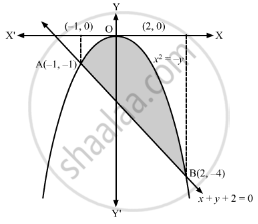
∴ Required area = Area of the shaded region OABO
\[= \left| \int_{- 1}^2 y_{\text{ line }} dx - \int_{- 1}^2 y_{\text{ parabola }} dx \right|\]
\[ = \left| \int_{- 1}^2 - \left( x + 2 \right)dx - \int_{- 1}^2 - x^2 dx \right|\]
\[ = \left.\left| {- \frac{\left( x + 2 \right)^2}{2}}\right|_{- 1}^2 +\left. \frac{x^3}{3}\right|_{- 1}^2 \right|\]
\[ = \left| - \frac{1}{2}\left( 16 - 1 \right) + \frac{1}{3}\left[ 8 - \left( - 1 \right) \right] \right|\]
\[ = \left| - \frac{15}{2} + 3 \right|\]
\[ = \left| - \frac{9}{2} \right|\]
\[ = \frac{9}{2}\text{ square units }\]
APPEARS IN
संबंधित प्रश्न
Find the area of the region bounded by the curve y = sinx, the lines x=-π/2 , x=π/2 and X-axis
Area bounded by the curve y = x3, the x-axis and the ordinates x = –2 and x = 1 is ______.
Sketch the graph of y = |x + 4|. Using integration, find the area of the region bounded by the curve y = |x + 4| and x = –6 and x = 0.
Using integration, find the area of the region bounded by the following curves, after making a rough sketch: y = 1 + | x + 1 |, x = −2, x = 3, y = 0.
Sketch the graph y = |x + 1|. Evaluate\[\int\limits_{- 4}^2 \left| x + 1 \right| dx\]. What does the value of this integral represent on the graph?
Find the area of the region bounded by x2 + 16y = 0 and its latusrectum.
Find the area of the region bounded by the curve \[a y^2 = x^3\], the y-axis and the lines y = a and y = 2a.
Find the area of the region common to the parabolas 4y2 = 9x and 3x2 = 16y.
Prove that the area in the first quadrant enclosed by the x-axis, the line x = \[\sqrt{3}y\] and the circle x2 + y2 = 4 is π/3.
Find the area of the region bounded by the parabola y2 = 2x + 1 and the line x − y − 1 = 0.
Using integration find the area of the region:
\[\left\{ \left( x, y \right) : \left| x - 1 \right| \leq y \leq \sqrt{5 - x^2} \right\}\]
Find the area of the circle x2 + y2 = 16 which is exterior to the parabola y2 = 6x.
Find the area bounded by the parabola x = 8 + 2y − y2; the y-axis and the lines y = −1 and y = 3.
If the area above the x-axis, bounded by the curves y = 2kx and x = 0, and x = 2 is \[\frac{3}{\log_e 2}\], then the value of k is __________ .
The area bounded by the curve y = loge x and x-axis and the straight line x = e is ___________ .
The area bounded by the curves y = sin x between the ordinates x = 0, x = π and the x-axis is _____________ .
The area bounded by the parabola y2 = 4ax and x2 = 4ay is ___________ .
Area bounded by parabola y2 = x and straight line 2y = x is _________ .
Sketch the graphs of the curves y2 = x and y2 = 4 – 3x and find the area enclosed between them.
Using integration, find the area of the region bounded by the parabola y2 = 4x and the circle 4x2 + 4y2 = 9.
Find the area of the region above the x-axis, included between the parabola y2 = ax and the circle x2 + y2 = 2ax.
Find the area of the region included between y2 = 9x and y = x
Find the area of region bounded by the line x = 2 and the parabola y2 = 8x
Using integration, find the area of the region bounded by the line 2y = 5x + 7, x- axis and the lines x = 2 and x = 8.
Find the area of the region bounded by y = `sqrt(x)` and y = x.
Find the area bounded by the curve y = `sqrt(x)`, x = 2y + 3 in the first quadrant and x-axis.
Find the area of region bounded by the triangle whose vertices are (–1, 1), (0, 5) and (3, 2), using integration.
The area of the region bounded by the circle x2 + y2 = 1 is ______.
The area of the region bounded by the curve x = 2y + 3 and the y lines. y = 1 and y = –1 is ______.
Using integration, find the area of the region in the first quadrant enclosed by the line x + y = 2, the parabola y2 = x and the x-axis.
Find the area of the region bounded by the curve `y^2 - x` and the line `x` = 1, `x` = 4 and the `x`-axis.
What is the area of the region bounded by the curve `y^2 = 4x` and the line `x` = 3.
Find the area of the region enclosed by the curves y2 = x, x = `1/4`, y = 0 and x = 1, using integration.
Let f(x) be a non-negative continuous function such that the area bounded by the curve y = f(x), x-axis and the ordinates x = `π/4` and x = `β > π/4` is `(βsinβ + π/4 cos β + sqrt(2)β)`. Then `f(π/2)` is ______.
Let P(x) be a real polynomial of degree 3 which vanishes at x = –3. Let P(x) have local minima at x = 1, local maxima at x = –1 and `int_-1^1 P(x)dx` = 18, then the sum of all the coefficients of the polynomial P(x) is equal to ______.
Using integration, find the area of the region bounded by line y = `sqrt(3)x`, the curve y = `sqrt(4 - x^2)` and Y-axis in first quadrant.
Evaluate:
`int_0^1x^2dx`
