Advertisements
Advertisements
प्रश्न
Find the area bounded under the curve y = 3x2 + 6x + 7 and the X-axis with the ordinates at x = 5 and x = 10.
Advertisements
उत्तर
The given equation of the curve is y = 3x2 + 6x + 7.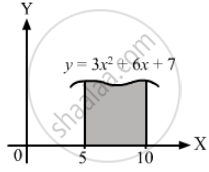
The area bounded by the curve and the X-axis with coordinates x1 = 5 and x2 = 10 is given by
\[\int_{x_1}^{x_2} y dx\]
\[ = \int_5^{10} \left( 3 x^2 + 6x + 7 \right)dx\]
\[ = \left[ \frac{3 x^3}{3} + \frac{6 x^2}{2} + 7x \right]_5^{10} \]
\[ = 1000 - 125 + 300 - 75 + 70 - 35\]
\[ = 1370 - 235\]
= 1135 sq. units
APPEARS IN
संबंधित प्रश्न
It is often said that the world is witnessing now a second industrial revolution, which will transform the society as radically as did the first. List some key contemporary areas of science and technology, which are responsible for this revolution.
Write in about 100 words a fiction piece based on your speculation on the science and technology of the twenty-second century.
Attempt to formulate your ‘moral’ views on the practice of science. Imagine yourself stumbling upon a discovery, which has great academic interest but is certain to have nothing but dangerous consequences for the human society. How, if at all, will you resolve your dilemma?
Suppose you are told that the linear size of everything in the universe has been doubled overnight. Can you test this statement by measuring sizes with a metre stick? Can you test it by using the fact that the speed of light is a universal constant and has not changed? What will happen if all the clocks in the universe also start running at half the speed?
Suggest a way to measure the distance between the sun and the moon.
Find the dimensions of electric dipole moment p .
The defining equations are p = q.d and M = IA;
where d is distance, A is area, q is charge and I is current.
Find the dimensions of magnetic dipole moment M.
The defining equations are p = q.d and M = IA;
where d is distance, A is area, q is charge and I is current.
Express the power of a 100 watt bulb in CGS unit.
A particle moves on a given straight line with a constant speed ν. At a certain time it is at a point P on its straight line path. O is a fixed point. Show that \[\vec{OP} \times \vec{\nu}\] is independent of the position P.
The force on a charged particle due to electric and magnetic fields is given by \[\vec{F} = q \vec{E} + q \vec{\nu} \times \vec{B}\].
Suppose \[\vec{E}\] is along the X-axis and \[\vec{B}\] along the Y-axis. In what direction and with what minimum speed ν should a positively charged particle be sent so that the net force on it is zero?
The electric current in a discharging R−C circuit is given by i = i0 e−t/RC where i0, R and C are constant parameters and t is time. Let i0 = 2⋅00 A, R = 6⋅00 × 105 Ω and C = 0⋅500 μF. (a) Find the current at t = 0⋅3 s. (b) Find the rate of change of current at at 0⋅3 s. (c) Find approximately the current at t = 0⋅31 s.
Find the area enclosed by the curve y = sin x and the X-axis between x = 0 and x = π.
Find the area bounded by the curve y = e−x, the X-axis and the Y-axis.
A rod of length L is placed along the X-axis between x = 0 and x = L. The linear density (mass/length) ρ of the rod varies with the distance x from the origin as ρ = a + bx. (a) Find the SI units of a and b. (b) Find the mass of the rod in terms of a, b and L.
