Advertisements
Advertisements
प्रश्न
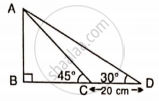
Find AB and BC, if:
बेरीज
Advertisements
उत्तर
Let BC = x m
BD = BC + CD = (x + 20) cm
In ΔABD,
tan 30° = `"AB"/"BD"`
`(1)/(sqrt(3)) = "AB"/(x + 20)`
x + 20 = `sqrt(3)"AB"` .....(1)
In ΔABC
tan 45° = `"AB"/"BC"`
1 = `"AB"/x`
AB = x ...(2)
From (1)
AB + 20 = `sqrt(3)"AB"`
AB`(sqrt(3)-1) = 20`
AB = `(20)/((sqrt3 - 1))`
= `(20)/((sqrt3 - 1)) xx ((sqrt(3) + 1))/((sqrt(3) + 1))`
= `(20(sqrt(3)+1))/(3 - 1)`
= 27.32cm
From (2)
AB = x = 27.32 cm
Therefore BC = x = AB = 27.32 cm
Therefore, AB = 27.32 cm, BC = 27.32 cm
shaalaa.com
Solution of Right Triangles
या प्रश्नात किंवा उत्तरात काही त्रुटी आहे का?
पाठ 22: Solution of Right Triangles [Simple 2-D Problems Involving One Right-angled Triangle] - TEST YOURSELF [पृष्ठ ३४४]
