Advertisements
Advertisements
प्रश्न
Fill in the blanks:
Bengal in the 18th century was the _______ and the most _________ province in India.
Advertisements
उत्तर
Bengal in the 18th century was the richest and the most fertile province in India.
APPEARS IN
संबंधित प्रश्न
Match the Column:
| Column A | Column B |
| 1. Carnatic Wars | (a) Warren Hastings |
| 2. Farman | (b) duty-free trade |
| 3. Roberts Clive | (c) reconquered Calcutta |
| 4. Battle of Plassey | (d) Siraj-ud-Daulah |
| 5. Battle of Buxar | (e) Anglo-French rivalry |
| 6. Governor of Bengal | (f) Mir Qasim |
Choose the correct answer:
The Battle of Plassey was fought in _______.
State whether the following is true or false:
Warren Hastings laid the foundation of an organized system of government in Bengal.
Answer the following question in one or two words/sentences:
Why did the farman of 1717 become a bone of contention between the nawabs of Bengal and the British Company?
Answer the following question briefly:
Mir Qasim was a competent ruler, determined to free himself from foreign control. In this context answer the following:
Explain the importance of the Battle of Buxar.
Answer the following question briefly:
With reference to the Treaty of Allahabad and its impact, answer the following:
Explain how the treaty between Robert Clive and the Mughal emperor Shah Alam II legalized English East India’s Company’s control over Bengal.
This picture portrays a momentous event in 1765, involving a British Governor and a Mughal emperor wherein the Mughal emperor is conveying the grant of the Diwani to the governor.
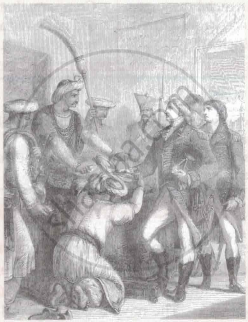
Give a brief account of the battle that preceded this event. When did it take place?
Why did Siraj-ud-Daulah lose the Battle of Plassey?
State the following Statement is True or False:
The Battle of Buxar led to the foundation of British empire in India.
Answer the following question:
What were the results and significance of the Battle of Buxar?
