Advertisements
Advertisements
प्रश्न
Answer the following question:
What were the results and significance of the Battle of Buxar?
Advertisements
उत्तर
The Treaty of Allahabad was signed in 1765. According to its term, the Nawab surrendered the districts of Allahabad and Kara to the Mughal Emperor Shah Alam. The Nawab agreed to pay 50 lakh rupees to the company. The Mughal Emperor granted the Diwani of Bengal, Bihar, and Orissa to the British. In return, the company agreed to pay T 26 lakhs annually to him. The company for the first time getting involved in the direct administration of Bengal.
APPEARS IN
संबंधित प्रश्न
Fill in the blanks:
__________, ___________ and __________ became the headquarters of the British settlements in the southern, western, and eastern regions, respectively.
Fill in the blank:
The French East India Company was established in __________.
Fill in the blanks:
In __________ Robert Clive recovered Calcutta which had been captured by Siraj-ud-Daulah in ___________.
Choose the correct answer:
Alivardi Khan was succeeded by __________.
State whether the following is true or false:
Warren Hastings laid the foundation of an organized system of government in Bengal.
State whether the following is true or false:
The British army was defeated in the Battle of Buxar.
Answer the following question briefly:
With reference to the Treaty of Allahabad and its impact, answer the following:
Explain how the treaty between Robert Clive and the Mughal emperor Shah Alam II legalized English East India’s Company’s control over Bengal.
This picture portrays a momentous event in 1765, involving a British Governor and a Mughal emperor wherein the Mughal emperor is conveying the grant of the Diwani to the governor.
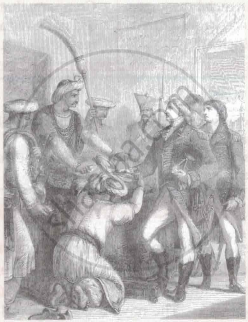
Give a brief account of the battle that preceded this event. When did it take place?
When and between whom was the Battle of Buxar fought?
What was the result of the British victory in the Battle of Buxar?
