Advertisements
Advertisements
प्रश्न
Explain the statement - ‘we have got this Earth planet on lease from our future generations and not as an ancestral property from our ancestors.’
Advertisements
उत्तर
- The earth was inhabited by previous generations before us, and now we have taken their place.
- During their lifetimes, they caused harmful effects on the earth through industrialization, excessive use of natural resources, wars, the construction of dams, roads, and bridges, and large-scale deforestation.
- Although these activities were carried out for the development of mankind, many of them disturbed the delicate balance between producers and different levels of consumers.
- The continuously increasing human population has created a shortage of food, clothing and shelter. To meet these basic needs, natural resources have been overexploited, resulting in the destruction of Earth’s ecosystems.
- It is now our responsibility to protect the Earth because future generations must also live on this planet. We must pass on a well-balanced ecosystem to them.
- Future generations require clean air, pure water, fertile land and the presence of all other living organisms for a healthy life.
- Environmental problems such as climate change, global warming, pollution and droughts have affected the Earth. Therefore, to maintain its sustainability, we must remember that the Earth is not only our ancestral property but also a legacy that must be preserved for future generations.
APPEARS IN
संबंधित प्रश्न
Which businesses will you start near the agro-tourism center?
Write a short note on disaster and its management.
How will you justify that overcoming the pollution is a powerful way of environmental management?
Which projects will you run in relation to environmental conservation? How?
How can biodiversity be conserved?
Complete the following chart:

Attempts at various levels are performed for conserving environment. Which role would you like to perform. Give two actions each:
- Prevention
- Control
- Production
- Awareness
- Conservation
Earthquake : Natural factor : : Industrialization : : _____________
What is environmental pollution?
What initiatives will you take regarding environmental conservation? Write how.
______ of our environment means to protect all things found in nature.
We should conserve our natural resources and energy
What is meant by conservation of environment?
Even today there is a need for movements like 'Chipko' movement. Explain this with the help of an example that you have experienced.
Complete the following table taking into account the relation between the entries in three columns:
| Air pollution | Water pollution | Soil pollution | |
| Components | Gases: CO2, CO, Hydrocarbons, Sulphur, NOx, Hydrogen sulphides etc. Solid: dust, ash, carbon, lead, asbestos, etc. |
||
| Source | Industrial wastes, Domestic wastes, Sewage, Chemicals discharged from Industries, Pesticides used in agriculture. |
||
| Effect | Soil erosion, Retarded growth of plants/crops, Nutritional deficiency etc. | ||
| Control Measure |
Name the act under which trading of rare animals has been completely banned.
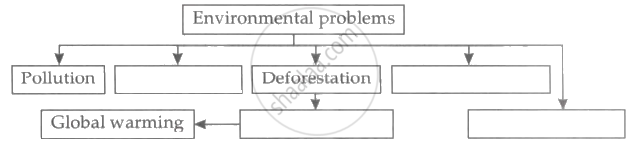
Complete the following conceptual picture:
Give two sources of air pollution.
Mention one measure to control air pollution.
