Advertisements
Advertisements
प्रश्न
Explain the following statement with reason.
Chandrasingh Thakur was court martialled and severely punished.
Advertisements
उत्तर
Gandhiji has protested against the salt law of the British. He had formed a satyagraha movement for the same. Many of the peaceful protestors were beaten and jailed by the British. This led to many other movements as well. One such movement was Khuda-i-Khidmatgar by Khan Abdul Gafar Khan. It was a Pashtun nonviolent movement against the British. It was originally initiated as a social reform for the progress of education and removal of a blood feud. This was also called ‘Red Shirts’. However, it became more political as most of its members became targets of the British. Gaffar Khan was arrested, and demonstrations began in Peshawar for his freedom.
To solve this issue, the Royal Garhwal Rifles were asked to board the buses that would take them to Peshawar, where they were ordered to open fire on the protestors and cause a riot. Chandrasingh Thakur was the commander of this army. He refused to do so and was court-martialled and severely punished.
संबंधित प्रश्न
With reference to the National Movement from 1930 to 1947, answer the following :
State any three features of the Programmed of the Civil Disobedience Movement launched in 1930.
______ organised the Round Table Conference in London.
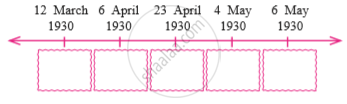
Complete the following timeline of Civil Disobedience Movement.
Plot on an outline map of India ,the places mentioned in the chapter where the Civil Disobedience Movement took place.
Gather additional information along with photographs about the work of the following personality in the Civil Disobedience Movement and exhibit it in the class.
Sarojini Naidu:
What did the programme of Civil Disobedience consist of?
What was the reaction of the Muslim League to the Nehru Report?
Briefly state the outcome of the Civil Disobedience Movement.
How did the people of India react of the appointment of Simon Commission.
The Civil Disobedience Movement was significant in the history of the National Movement. With-reference to this movement, write short notes on the circumstances leading to Civil Disobedience Movement.
