Advertisements
Advertisements
प्रश्न
Explain the role of pituitary and the ovarian hormones in menstrual cycle in human females
Advertisements
उत्तर
Menstrual cycle starts with menstrual flow (3 to 5 days), caused due to the breakdown of the endometrium of the uterus, which is followed by the follicular phase. In this phase, the primary follicles mature into the Graffian follicles. This causes the regeneration of the endometrium.
These changes are brought about by ovarian and pituitary hormones.
• In this phase, the release of gonadotropins (LH and FSH) increases. This causes follicular growth and the growing follicles produce oestrogen.
• The LH and FSH are at their peak in the middle of the cycle (14th day), and cause the rupture of the Graffian follicles to release ovum. This phase is called the ovulatory phase.
• The remains of the Graffian follicles get converted into the corpus luteum, which secretes progesterone for the maintenance of the endometrium.
APPEARS IN
संबंधित प्रश्न
What is menstrual cycle?
Explain the ovarian cycle with its different phases.
Follicle stimulating hormone : Development of oocyte : : Luteinizing hormone : ____________
Progesterone peaks during which phase of the menstrual cycle?
How long does the secretory phase of the menstrual cycle last?
Immediately after ovulation, the mammalian egg is covered by a membrane known as ______.
To answer the question, study the graphs below for Subjects 1 and 2 showing different levels of certain hormones.
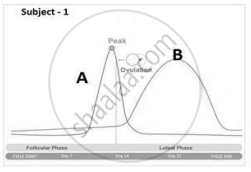
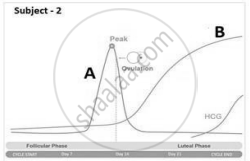
The peak observed in Subject 1 and 2 is due to ______
A biology student after studying the different levels of hormones during the menstrual cycle was comparing 2 subjects (Patients). A table was created after looking at the levels of hormones A and B for Subjects 1 and 2. Read the information in the table and answer the question that follows.
| HORMONE A | HORMONE B | |
| Subject 1 | Shows a peak on the 14th Day of the menstrual cycle. | Falls down during the luteal phase. |
| Subject 2 | Shows a peak on the 14th Day of the menstrual cycle. | The level is maintained high in the luteal phase. |
For subject 2 it is observed that the peak for hormone B has reached the plateau stage. After approximately how much time will the curve for hormone B descend?
Write a short note on Secretory Phase.
The onset of menstruation in women is called ______.
