Advertisements
Advertisements
प्रश्न
Explain the post-pollination events leading to seed production in angiosperms.
Advertisements
उत्तर
Pollination is the process of transfer of pollen grains from anther to stigma.
-
When the pollen grains fall on the stigma, the pollen tube enters one of the synergids and releases two male gametes.
-
One of the male gametes moves towards the egg cell and fuses with it to form zygote.
-
The other male gamete fuses with the two polar nuclei and forms the primary endosperm nucleus. This is termed as triple fusion.
-
After the triple fusion, the central cell becomes the primary endosperm cell (PEC).
-
The primary endosperm nucleus gives rise to endosperm, while the zygote develops into embryo.
- Seeds are the fertilised ovules that are developed inside a fruit.
- The integuments of ovules harden to form the seed coat, and the micropyle facilitates the entry of oxygen and water into the seed.
APPEARS IN
संबंधित प्रश्न
Can a unisexual flower be self pollinated?
Explain water pollination in detail with its types.
For which of the following attractants and rewards are required?
Triple fusion in Capsella bursa pastoris is fusion of male gamete with ______.
Which type of flower has ovary superior?
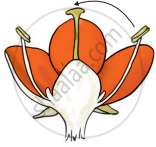
Which type of pollination does the figure indicate?
Match the Column I with Column II.
| Column I | Column II |
| A. Pea | (i) Xenogamy |
| B. Jawar | (ii) Epihydrophily |
| C. Maize | (iii) Anemophily |
| D. Vallis | (iv) Bisexual |
| E. Cannabis | (v) Geitonogamy |
What is epihydrophily?
Comparatively a large amount of pollen grains are wasted during ______.
Geitonogamy is characterized by which of the following?
