Advertisements
Advertisements
प्रश्न
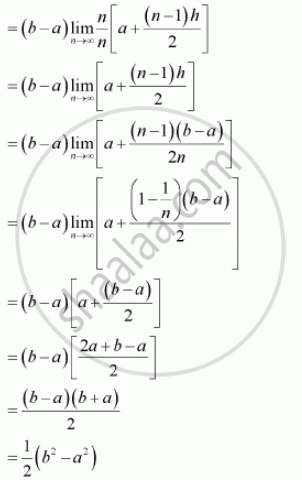
Evaluate the following definite integrals as limit of sums.
`int_a^b x dx`
Advertisements
उत्तर

APPEARS IN
संबंधित प्रश्न
Evaluate the following definite integrals as limit of sums.
`int_0^5 (x+1) dx`
Evaluate the following definite integrals as limit of sums.
`int_2^3 x^2 dx`
Evaluate the following definite integrals as limit of sums `int_(-1)^1 e^x dx`
Evaluate the definite integral:
`int_(pi/2)^pi e^x ((1-sinx)/(1-cos x)) dx`
Evaluate the definite integral:
`int_0^(pi/4) (sinx cos x)/(cos^4 x + sin^4 x)`dx
Evaluate the definite integral:
`int_0^(pi/2) (cos^2 x dx)/(cos^2 x + 4 sin^2 x)`
Evaluate the definite integral:
`int_(pi/6)^(pi/3) (sin x + cosx)/sqrt(sin 2x) dx`
Evaluate the definite integral:
`int_0^(pi/4) (sin x + cos x)/(9+16sin 2x) dx`
Evaluate the definite integral:
`int_1^4 [|x - 1|+ |x - 2| + |x -3|]dx`
Prove the following:
`int_0^1 xe^x dx = 1`
Prove the following:
`int_(-1)^1 x^17 cos^4 xdx = 0`
Evaluate `int_0^1 e^(2-3x) dx` as a limit of a sum.
`int dx/(e^x + e^(-x))` is equal to ______.
If f (a + b - x) = f (x), then `int_a^b x f(x )dx` is equal to ______.
Evaluate : `int_1^3 (x^2 + 3x + e^x) dx` as the limit of the sum.
\[\int\limits_0^1 \left( x e^x + \cos\frac{\pi x}{4} \right) dx\]
Evaluate the following integral:
\[\int\frac{\sqrt{\tan x}}{\sin x \cos x} dx\]
Solve: (x2 – yx2) dy + (y2 + xy2) dx = 0
Evaluate:
`int (sin"x"+cos"x")/(sqrt(9+16sin2"x")) "dx"`
Evaluate the following as limit of sum:
`int _0^2 (x^2 + 3) "d"x`
Evaluate the following:
`int_0^2 ("d"x)/("e"^x + "e"^-x)`
Evaluate the following:
`int_0^1 (x"d"x)/sqrt(1 + x^2)`
The limit of the function defined by `f(x) = {{:(|x|/x",", if x ≠ 0),(0",", "otherwisw"):}`
The value of `lim_(n→∞)1/n sum_(r = 0)^(2n-1) n^2/(n^2 + 4r^2)` is ______.
