Advertisements
Advertisements
प्रश्न
Draw the electron dot structure of covalent compound methane (non polar) and HCL (polar) and give two difference between them.
Advertisements
उत्तर
| Methane (non polar) | HCL (polar) |
| Covalent compounds are non polar when shared pairs of electron(s) are equally distributed between the two atoms. | Covalent compounds are said to be polar when the shared pair of electrons are not at equal distance between the two atoms. |
| No charge separation takes place. The covalent molecule is symmetrical and electrically neutral. | Charge separation takes place. The atom which attracts electrons more strongly develops a slight negative charge while the other creates a little positive charge. |
| \[\begin{array}{cc} \ce{H}\\ \ce{H:\underset{..}{\overset{..}{C}} :H}\\ \ce{H} \end{array}\] |
\[\ce{H:\underset{..}{\overset{..}{Cl}}}\] |
APPEARS IN
संबंधित प्रश्न
List three characteristic properties of covalent compounds.
State whether the following statement is true or false:
Diamond and graphite are the covalent compounds of carbon element (C).
Name a carbon containing molecule which has two double bonds.
For each compound mentioned above give the formulae of ions formed in aqueous solution.
Give two example in following case:
Liquid non polar compounds
The molecule which contains a triple covalent bond is ______.
Covalent bonds can be single, double or triple covalent bonds. How many electrons are shared in each? Give an example of each type.
Give an example of the covalent bond formed by
(i) Similar atoms (ii) Dissimilar atoms
Fill in the blank and rewrite the completed statement:
Covalent compounds are generally soluble in _________ solvents.
Complete the following activity.
Write the names of the hydrocarbons for the following structural formula.
(isobutylene, cyclohexane, propene, cyclohexene, cyclopentane, benzene, propyne, isobutane, propane)
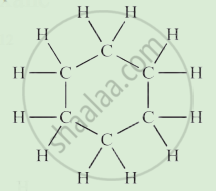 |
