Advertisements
Advertisements
प्रश्न
Draw a rough sketch of the graph of the function y = 2 \[\sqrt{1 - x^2}\] , x ∈ [0, 1] and evaluate the area enclosed between the curve and the x-axis.
Advertisements
उत्तर
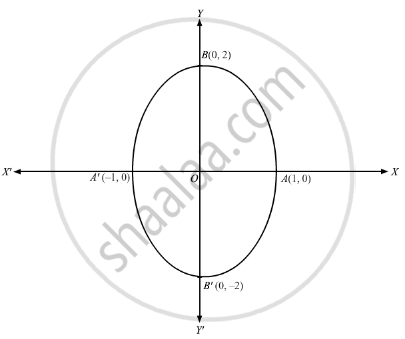
We have,
\[y = 2\sqrt{1 - x^2}\]
\[ \Rightarrow \frac{y}{2} = \sqrt{1 - x^2}\]
\[ \Rightarrow \frac{y^2}{4} = 1 - x^2 \]
\[ \Rightarrow x^2 + \frac{y^2}{4} = 1\]
\[ \Rightarrow \frac{x^2}{1} + \frac{y^2}{4} = 1\]
\[\text{ Since in the given equation } \frac{x^2}{1} + \frac{y^2}{4} = 1,\text{ all the powers of both }x\text{ and }y\text{ are even, the curve is symmetrical about both the axes }. \]
\[ \therefore\text{ Required area = area enclosed by ellipse and }x - \text{ axis in first quadrant }\]
\[(1, 0 ), ( - 1, 0) \text{ are the points of intersection of curve and }x - \text{ axis }\]
\[(0, 2), (0, - 2) \text{ are the points of intersection of curve and }y - \text{ axis }\]
\[\text{ Slicing the area in the first quadrant into vertical stripes of height }= \left| y \right|\text{ and width }= dx\]
\[ \therefore\text{ Area of approximating rectangle }= \left| y \right| dx\]
\[\text{ Approximating rectangle can move between }x = 0\text{ and }x = 1 \]
\[\text{ A = Area of enclosed curve above }x -\text{ axis }= \int_0^1 \left| y \right| dx\]
\[ \Rightarrow A = \int_0^1 2\sqrt{1 - x^2} d x\]
\[ = 2 \int_0^1 \sqrt{1 - x^2} d x\]
\[ = 2 \left[ \frac{1}{2}x\sqrt{1 - x^2} + \frac{1}{2} \sin^{- 1} x \right]_0^1 \]
\[ = 2\left\{ \frac{1}{2} \sin^{- 1} 1 \right\}\]
\[ = 2\left\{ \frac{1}{2}\left( \frac{\pi}{2} - 0 \right) \right\}\]
\[ \Rightarrow A = \frac{\pi}{2}\text{ sq . units }\]
APPEARS IN
संबंधित प्रश्न
Find the area bounded by the curve y2 = 4ax, x-axis and the lines x = 0 and x = a.
Find the area of the region bounded by the curve y = sinx, the lines x=-π/2 , x=π/2 and X-axis
Find the area bounded by the curve y = sin x between x = 0 and x = 2π.
Using integration, find the area of the region bounded by the line y − 1 = x, the x − axis and the ordinates x= −2 and x = 3.
Find the area lying above the x-axis and under the parabola y = 4x − x2.
Draw a rough sketch to indicate the region bounded between the curve y2 = 4x and the line x = 3. Also, find the area of this region.
Make a rough sketch of the graph of the function y = 4 − x2, 0 ≤ x ≤ 2 and determine the area enclosed by the curve, the x-axis and the lines x = 0 and x = 2.
Sketch the graph of y = \[\sqrt{x + 1}\] in [0, 4] and determine the area of the region enclosed by the curve, the x-axis and the lines x = 0, x = 4.
Find the area under the curve y = \[\sqrt{6x + 4}\] above x-axis from x = 0 to x = 2. Draw a sketch of curve also.
Find the area bounded by the curve y = 4 − x2 and the lines y = 0, y = 3.
Find the area of the region \[\left\{ \left( x, y \right): \frac{x^2}{a^2} + \frac{y^2}{b^2} \leq 1 \leq \frac{x}{a} + \frac{y}{b} \right\}\]
Using integration, find the area of the region bounded by the triangle whose vertices are (2, 1), (3, 4) and (5, 2).
Find the area of the region bounded by \[y = \sqrt{x}, x = 2y + 3\] in the first quadrant and x-axis.
Find the area of the region bounded by the parabola y2 = 2x + 1 and the line x − y − 1 = 0.
Make a sketch of the region {(x, y) : 0 ≤ y ≤ x2 + 3; 0 ≤ y ≤ 2x + 3; 0 ≤ x ≤ 3} and find its area using integration.
Using integration, find the area of the following region: \[\left\{ \left( x, y \right) : \frac{x^2}{9} + \frac{y^2}{4} \leq 1 \leq \frac{x}{3} + \frac{y}{2} \right\}\]
Find the area of the figure bounded by the curves y = | x − 1 | and y = 3 −| x |.
If the area above the x-axis, bounded by the curves y = 2kx and x = 0, and x = 2 is \[\frac{3}{\log_e 2}\], then the value of k is __________ .
The area included between the parabolas y2 = 4x and x2 = 4y is (in square units)
The area bounded by the curve y = 4x − x2 and the x-axis is __________ .
The area of the region (in square units) bounded by the curve x2 = 4y, line x = 2 and x-axis is
Using integration, find the area of the region bounded by the line x – y + 2 = 0, the curve x = \[\sqrt{y}\] and y-axis.
Find the area of the region bounded by the curve y2 = 4x, x2 = 4y.
Using integration, find the area of the region bounded by the line 2y = 5x + 7, x- axis and the lines x = 2 and x = 8.
The area of the region bounded by the ellipse `x^2/25 + y^2/16` = 1 is ______.
Using integration, find the area of the region bounded between the line x = 4 and the parabola y2 = 16x.
Find the area of the region bounded by `x^2 = 4y, y = 2, y = 4`, and the `y`-axis in the first quadrant.
Find the area of the region bounded by the ellipse `x^2/4 + y^2/9` = 1.
Smaller area bounded by the circle `x^2 + y^2 = 4` and the line `x + y = 2` is.
Make a rough sketch of the region {(x, y): 0 ≤ y ≤ x2, 0 ≤ y ≤ x, 0 ≤ x ≤ 2} and find the area of the region using integration.
Using integration, find the area of the region bounded by the curves x2 + y2 = 4, x = `sqrt(3)`y and x-axis lying in the first quadrant.
The area of the region S = {(x, y): 3x2 ≤ 4y ≤ 6x + 24} is ______.
The area (in sq.units) of the region A = {(x, y) ∈ R × R/0 ≤ x ≤ 3, 0 ≤ y ≤ 4, y ≤x2 + 3x} is ______.
Let P(x) be a real polynomial of degree 3 which vanishes at x = –3. Let P(x) have local minima at x = 1, local maxima at x = –1 and `int_-1^1 P(x)dx` = 18, then the sum of all the coefficients of the polynomial P(x) is equal to ______.
Using integration, find the area of the region bounded by line y = `sqrt(3)x`, the curve y = `sqrt(4 - x^2)` and Y-axis in first quadrant.
Using integration, find the area of the region bounded by y = mx (m > 0), x = 1, x = 2 and the X-axis.
Using integration, find the area bounded by the curve y2 = 4ax and the line x = a.
Evaluate:
`int_0^1x^2dx`
