Advertisements
Advertisements
प्रश्न
Draw a neat diagram to explain the action of a convergent (convex) lens as a reading glass (or magnifying glass). State the characteristics of the image formed.
Advertisements
उत्तर
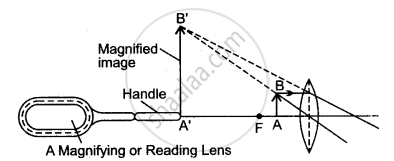
The object to be seen must be placed from the convex lens at a distance less than its focal length.
Characteristics of the image so formed are:
(i) It is virtual and upright.
(ii) It is magnified.
(iii) The image is formed towards the object side.
संबंधित प्रश्न
Where is the object placed with respect to the principal focus of a magnifying glass, so as to see its enlarged image? Where is the image obtained?
An object is placed at a distance of 20 cm in front of a concave lens of focal length 20 cm. find: the magnification of image.
Define the term magnifying power of a simple microscope. How does it depend on the focal length of the lens used?
Name the lens for which magnification can be 1. For what position of the object will the magnification be 1?
Name the lens for which magnification is always less than 1.
How is the magnification (m) produced by a lens related to the object distance (u) and the image distance (v)?
An erect, magnified, and a virtual image is formed when an object is placed between the optical centre and principal focus of a lens.
(i) Name the lens.
(ii) Draw a ray diagram to show the formation of the image with the above-stated characteristics.
What is a magnifying glass (or a simple microscope)? Draw a ray diagram to show how a convex lens may be used as a magnifying glass. Where should the object be placed? State three characteristics of the image formed.
(i) Draw a ray diagram to show how the lens can be used as a ‘magnifying glass’? State the nature of the lens.
(ii) In what respect does the image in (i) above different from the image formed by a concave lens?
State two uses of magnifying glass.
