Advertisements
Advertisements
प्रश्न
Do humans kneel to other humans who lived thousands of years ago? Discuss this in groups.
Advertisements
उत्तर
Yes, humans kneel to other humans who lived thousands of years ago as it is a cultural tradition to do so. (Students can discuss their own culture with their classmates and share the rituals and traditions of their culture and also get to know about other cultural practices.)
संबंधित प्रश्न
I think I could turn and live with animals, they are
so placid and self-contain’d
I stand and look at them long and long.
They do not sweat and whine about their condition,
They do not lie awake in the dark and weep for their sins,
They do not make me sick discussing their duty to God,
Not one is dissatisfied, not one is demented with
the mania of owning things.
Not one kneels to another, nor to his kind that
lived thousands of years ago,
Not one is respectable or unhappy over the whole earth.
So they show their relations to me and I accept them,
They bring me tokens of myself, they evince
them plainly in their possession
I wonder where they get those tokens,
Did I pass that way huge times ago and negligently drop them?
(A1) Complete the following sentences with the help of the poem.
(a) The poet wishes he could.............................
(b) Animals do not complain about............................
(c) Animals do not merely discuss.............................
(d) Animals are not crazy about .............................
(A2) The qualities of animals that highlighted by the poet in the poem are
.............................................................................................................
............................................................................................................
..........................................................................................................
(A3) Name and explain the figures of speech.
“I stand and look at them long and long.’’
What are the ‘tokens’ that the poet says he may have dropped long ago, and which the animals have kept for him? Discuss this in class .
(Hint Whitman belongs to the Romantic tradition that includes Rousseau and Wordsworth,which holds that civilisation has made humans false to their own true nature.
What could be the basic aspects of our nature as living beings that humans choose to ignore or deny?)
Put the following attributes/abilities.
- self-control
- communicates
- love and care
- cooks
- good manners
- has 360° vision
- shows gratitude
- lives for more than 150 years
- swims
- learns computing
- worships god
- sleeps in standing position
- stands up immediately after birth
- brings up children
- belongs to various species
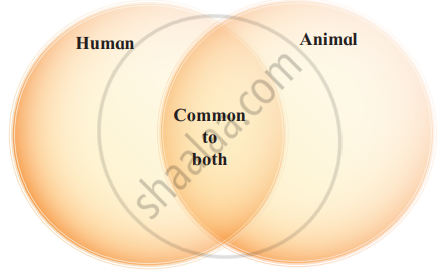
Find adjectives from the poem which refer to positive and negative thinking.
| Positive | Negative |
| 1. ................... | 1. ................... |
| 2. ................... | 2. ................... |
| 3. ................... | 3. ................... |
Animals are not crazy about ______.
State whether the following statement is true or false.
Animals are self-reliant.
State whether the following statement is true or false.
Animals do not worship other animals.
State whether the following statement is true or false.
Humans have given up many good qualities.
State whether the following statement is true or false.
Animals suffer humiliation.
With the help of the poem find the differences between animals and human beings.
| Human beings | Animals |
| Always complain about their condition | Never complain about anything |
Read the text again, and complete the web, highlighting the good values/habits which we can learn from animals.
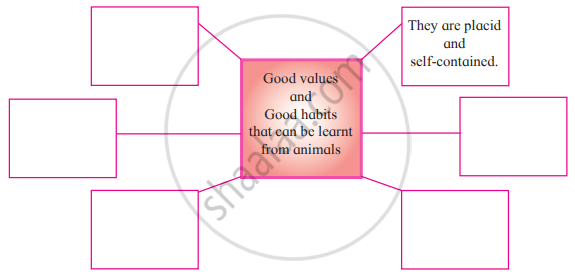
Read the poem again and write an appreciation of the poem in a paragraph format with the help of given points.
Points
- Title
- Poet
- Rhyme scheme
- Favourite line
- Theme/Central idea
- Figures of speech
- Special features - Type of the poem, language, tone, implied meaning, etc.
- Why I like/dislike the poem.
Read the following poem and write an appreciation of it with the help of the given points in a paragraph format:
|
Animals I think I could turn and live with animals, they are |
You can use the following points while appreciating the given poem.
- The title and the poet of the poem [1]
- Rhyme scheme [1]
- Figures of speech [1]
- Central Idea/Theme [2]
Justify how ‘Animals’ by Walt Whitman is a criticism of mankind and its ways.
Read the following extract and do the given activities.
A1. State whether the following statements are true or false: (2)
- Animals show their relations to us.
- Humans have given up many good qualities.
- Animals sweat and whine about their condition.
- Animals are placid and self-contained.
| I think I could turn and live with animals, they are so placid and self-contain'd, I stand and look at them long and long. They do not sweat and whine about their condition, They do not lie awake in the dark and weep for their sins, They do not make me sick discussing their duty to God, Not one is dissatisfied, not one is demented with the mania of owning things. Not one kneels to another, nor to his kind that lived thousands of years ago, Not one is respectable or unhappy over the whole earth, So they show their relations to me and I accept them, They bring me tokens of myself, they evince them plainly in their possession. I wonder where they get those tokens, Did I pass that way huge times ago and negligently drop them? |
A2. Answer the following question with the help of the given extract: (2)
(i) What craze do animals never display? Why?
A3. Pick out one example of Rhetorical question from the extract. (1)
Mention any two reasons why Walt Whitman appreciates animals more than humans.
Walt Whitman speaks of the human race with a tinge of sarcasm. Which are the two reasons that you agree with?
What two attributes of the Animals please the poet?
