Advertisements
Advertisements
प्रश्न
Distinguish between X andY chromosomes. (Mention any 'two' points.)
Advertisements
उत्तर
| No | X Chromosome | Y chromosome |
| 1 | These chromosomes are metacentric, hence appear X shaped. | These chromosomes are acrocentric, hence appear Y shaped |
| 2 | They are longer than ‘Y’ chromosomes | They are shorter than ‘X’ chromosomes |
| 3 | It contains large amount of euchromatin and small amount of heterochromatin. | It contains large amount of heterochromatin and small amount of euchromatin. |
| 4 | Found in both male and females. | Found only in males. |
| 5 | Non-homologous part shows more genes than Y chromosome. |
Non-homologous part contains few genes as compared to X chromosome. |
| 6 | X - linked genes are present on X chromosome. | Y- linked genes (Holandric genes) are present on Y chromosome. |
| 7 | Genes present on X chromosome show criss-cross inheritance. |
Genes present on Y chromosome show straight inheritance |
APPEARS IN
संबंधित प्रश्न
Choose the correct options of the following question:
Study the given monohybrid cross:
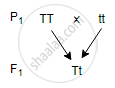
A test cross for this Fj will be:
Answer the following question.
Compare in any three ways the chromosomal theory of inheritance as proposed by Sutton and Bovery with that of experimental results on pea plant presented by Mendel.
Explain codominance in colour coat in cattle with checker board method.
If you cross dominant genotype PV/PV male Drosophila with double recessive female and obtain F1 hybrid. Now you cross F1 male with double recessive female.
What is the possible genotype in the F2 generation?
Telocentric chromosome differs from acrocentric chromosome in that ____________.
During cell division, spindle fibres get attached to the disc shaped structures present on the centromere are known as ______.
At secondary constriction I, ______ becomes organized during interphase.
Which of the following does NOT agree with chrotnosomal theory of inheritance?
In a certain taxon of insects some have 17 chromosomes and the others have 18 chromosomes. The 17 and 18 chromosome-bearing organisms are ______.
Which of the following is sex chromosomal disorder?
