Advertisements
Advertisements
प्रश्न
Distinguish between a real and a virtual image.
Advertisements
उत्तर
| Real image | Virtual image |
| 1. A real image is formed due to actual intersection of refracted (or reflected) rays | 1. A virtual image is formed when the refracted (or reflected) rays meet if they are produced backwards |
| 2. 2 A real image can be obtained on a screen | 2. 2. A virtual image cannot be obtained on a screen |
| 3. 3. A real image is inverted with respect to the object. | 3. 3. A virtual image is erect with respect to the object |
संबंधित प्रश्न
In the following figure (a) and (b), F1 and F2 are positions of the two foci of thin lenses. Draw the path taken by the light ray AB after it emerges from each lens.
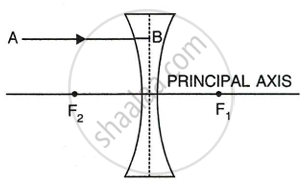 |
| (a) |
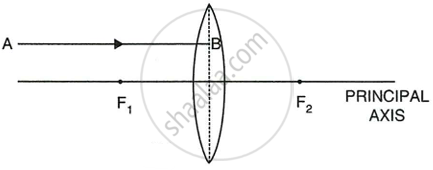 |
| (b) |
In figure, (a) and (b), F1 and F2 are the two foci of thin lenses and AB is the incident ray. Complete the diagram to show the path of the ray AB after refraction through each lens.
 |
| (a) |
 |
| (b) |
Fig shows an object PQ placed on the principle axis of a lens L. The two foci of the kens are F1 and f2. The image formed by the lens is erect, Virtual and dimnished.
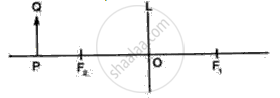
(i) Draw the outline ofthe lens L used and Named it.
(ii) Draw a ray of light starting from Q and passing through O. show the same ray after refraction by the lens.
(iii) Draw another ray from Q Which is incident parallel to the principle axis and show how it emerges after refraction from the lens.
(iv) Locate the final image formed.
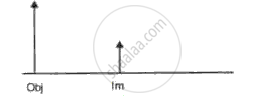
In the following diagram the object and the image formed by the respective lenses are shown. Complete the ray diagram, and locate the focus. Find the focal length of the lens.
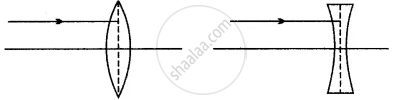
How will you differentiate between a convex and a concave lens by looking at a printed page?
When does a ray of light falling on a lens pass through it undeviated?
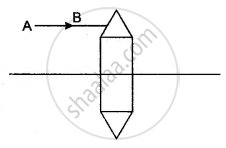
The diagram showed a lens as a combination of one glass block and two prisms. Complete the ray diagram and show the part of the incident ray AB after passing through the lens.
(i) Name of the lens formed by the combination.
(ii) What is the line XX’ called?
(iii) Mark the focus F.
Complete the following diagram and state what happens to the ray of light after refraction through the lens.