Advertisements
Advertisements
प्रश्न
Distinguish between
Print Media and Electronic Media.
Advertisements
उत्तर
| Sr. No. | Print Media | Electronic Media |
| 1. |
Most powerful means of communication. |
Communication to millions of people through electronic gadgets at the same time. |
| 2. |
Many newspapers carry information on local national and international events to the people. |
Radio, Television, Internet providers and create awareness on various national policies and programs. |
| 3. |
Knowledge of reading is essential. |
A powerful audio-visual medium. |
APPEARS IN
संबंधित प्रश्न
On what basis will you decide how many standard times should be there in a country?
What is communication? What are its types?
The largest terrestrial network of the world is ______.
Match the following:
| 1. | Eastern Railways | (a) | Telecommunication |
| 2. | Major Ports | (b) | India with Lahore |
| 3. | Bharath Sanchar Nigam | (c) | Kolkata |
| 4. | Satellite system | (d) | Port Trust of India |
| 5. | Major arterial roads | (e) | Indian remote sensing |
The ______ is the first communication Satellite in INSAT Series.
Indian Space Research organization was established in the year ______.
What are the advantages of a communication network?
Write the full form of STD, ISD, PCO, Internet.
Which longitude in India is considered as Indian Standard Time?
Study the map given in the figure and answer the following questions.
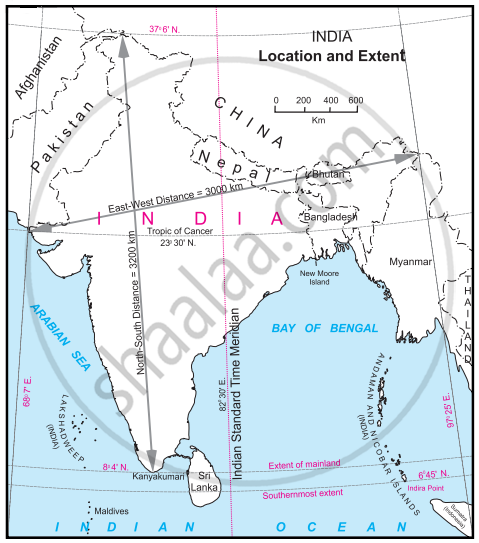
- Calculate the difference between the two longitudinal extremes of mainland India. Is it more than Brazil?
- Which longitude in India is called the Indian Standard Time (IST)?
- What is the difference between this time and the GMT?
- How many local times are there in India?
